Japan Chapter 6.1: Hiroshima… Meetings with Atomic-Bomb Survivors

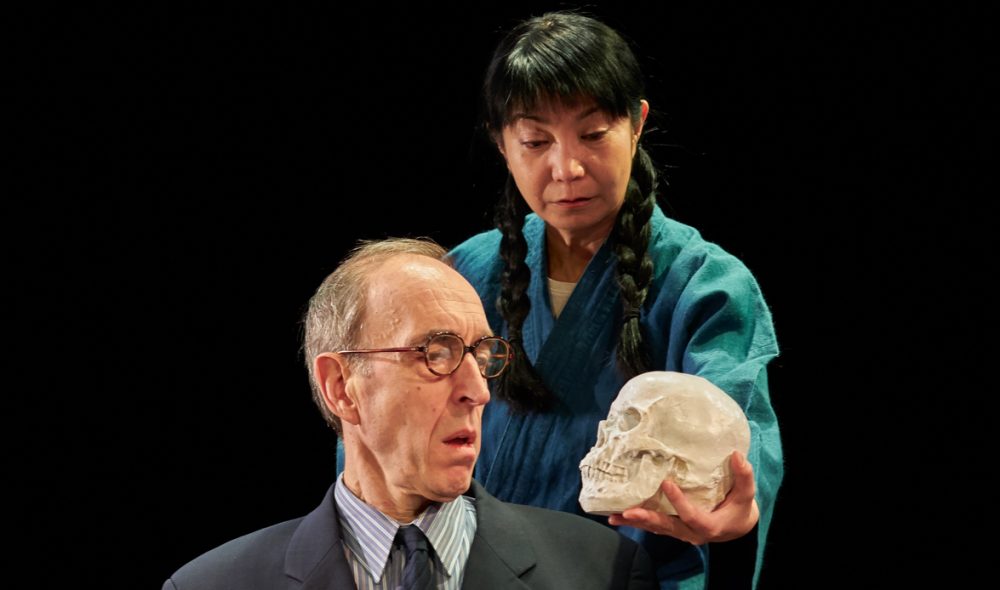
Saturday afternoon, October 4th, we take off from Hiroshima Airport to begin the long journey home.  What a week it’s been – this final week of our Japanese tour.

In Tottori City on Monday morning, after our two performances at Bird Theatre Festival, we are undecided how to get to Hiroshima with all of our baggage.  Six large suitcases, a number of smaller cases, and not forgetting the tatami mat used in the play as well.  

There’s a cheap bus all the way to Hiroshima, which is a very tempting option – until we discover that the bus-stop is fifty miles away.  The bullet-train beckons, but that would involve a change of trains and then hunting down at least two taxis at Hiroshima Station.  So the best option seems to be a minibus and driver – taking us from hotel door to hotel door – but this will cost a cool £500.  

I don’t even hesitate.  ‘Let’s do it – it will relieve us of so much stress.’  There have been savings in other parts of the budget so I feeI I can justify this expense.

From hotel door to hotel door; from cramped submarine-sized ‘cabin’ to stylish spacious apartment with all mod-cons – located right on Hiroshima’s Peace Boulevard.  After five nights cooped up like a budgerigar in my birdcage of a room in Tottori, at last – enough room in which to stretch out, walk about, dance around, open up my suitcases, spread all my clothes and papers about.  Room in which to think and reflect.

I feel many emotions coursing through me as the minibus draws ever nearer to the city which has taken up so much of my thinking, my feeling, my creativity, these last few years.  

Shortly after arriving, we meet up with Junko, our second wonderful Japanese collaborator for this tour, then head to the home of Toshiko Tanaka.  She is the gently inspiring 86-year-old atomic bomb survivor who I met and befriended in London last year – and who at that time invited Riko and myself to her home in Hiroshima should we ever get here. 

She’s waiting on the doorstep and when she recognizes me her face cracks open into a huge grin, a heart-melting beaming smile, as she takes my hand and says, ‘This is like a dream – a dream come true!’ 

Continue reading
Japan Chapter 5: A Japanese Boy’s Response to The Mistake …

Before we reach Hiroshima – the city that I feel I’ve lived in for much of the last decade, but a city that I’ve never actually visited – we have two other destinations.  In my case, Nara and Tottori.

It was hard to fill every week of this month-long tour with performances, so we now have two spare days before travelling to Tottori City in western Japan where we have been invited to perform at the Bird Theatre Festival. Riko spends the two days visiting her family in Osaka; Maria stays with family in Tokyo, whereas I have been thinking of revisiting Kyoto – which I last saw twenty five years ago on my only previous visit to Japan, with the Young Vic Theatre Company when we were performing Hamlet.

But Maria nudges me towards Nara, the ancient capital of Japan.  ‘If you like temples and shrines, you’ll find some beautiful ones there.’  So that’s what I do – head south on the Shinkansen bullet-train to Nara for two days.

‘On your way to the temples, watch out for the deer,’ Riko advises me.  ‘They’re everywhere and if you’re not careful they’ll eat your food.’

Continue reading

Japan Chapter 4: An English Tea Party…

‘I think it would have been good if you’d written something in the play about Okinawa and explored that…’. ‘I think it would have improved the play if there had been more history about the Japanese incursions into China…’

These comments from history students at Rugby School in Tokyo, who came to the theatre on Wednesday 17th September to see The Mistake

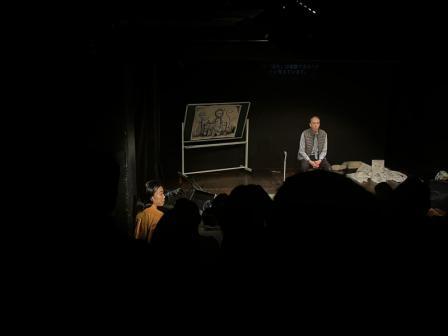
Yes, but… had I done the above, the play would be much longer and far less dramatic. The drama students from the school, however, were greatly taken with the staging, the simple props used in numerous ways, the character transitions, the swift switches in time and place – and all the students agreed that just two people telling such a powerful story in this way was, as one student kept reiterating: 

‘Admirable.  Really admirable.’

We were excited to have performed to two international schools but, as someone from the British Council in Japan said, after watching the play, ‘This really ought to be seen in Japanese schools.’  Yes, we’d love the opportunity to do that, but how? 

I need to find someone in Japan who could set up such performances…

We’d now worked seven days non-stop and so all needed a day off.  

Continue reading

Before the House Un-American Activities Commitee (well, kind of )

Scene:  a forbidding committee room arranged in the style of a courtroom.  A stern official – seated – is firing questions at a British actor/playwright – who is standing in front of him.

‘It has come to our attention that an audience member at a performance of your play The Error –

‘Mistake, your honour.’

‘Pardon me?’

‘The play is called The Mistake.’

‘Don’t interrupt again.  An audience member at a performance of your play deemed it to be un-American.

I must therefore ask, are you now or have you ever been a playwright who depicts the sufferings of innocent victims of war?  More specifically, a playwright who writes about the victims of American atomic bombs?  A playwright opposed to war in all its forms and to the military-industrial complex?’

‘Yes.  I am.  And I stand by everything I’ve written.  But it has never been my intention to create a work that was un-American.  I have tried to portray all sides of the debate, of the conflict.  Fairly.  To give every character the opportunity to vigorously make their case.’

But I’m getting ahead of myself.  Again.  Back to my first full day in New York City – Monday April 21st – before we’ve even entered the theatre which will be our home for the next three weeks.

I find myself singing as I walk the streets downtown with our director Rosamunde Hutt, who flew in the day before.

Continue reading

Sports, Religion, Sports, Peace, Sports Sports Sports…

The huge campus of the famous US university of Notre Dame in South Bend, Indiana, is a place where Holy Cross Drive intersects with Frank Leahy Drive.  

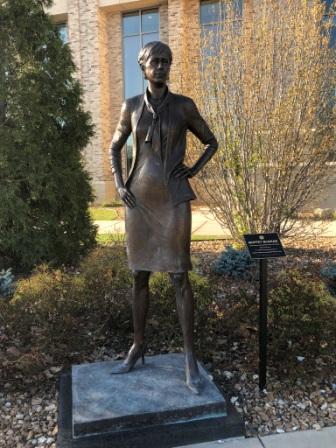
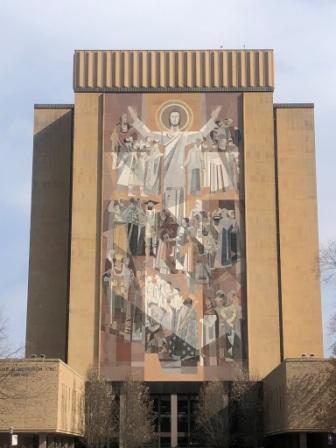
A place where you walk past sculptures of the same Frank Leahy (a famous Notre Dame football coach), then past a statue of the fabulously named women’s basketball coach Muffet McGraw (oh, yes) and then, after a short walk, past the huge, beautiful mural known as Touchdown Jesus.

 I kid you not.  Jesus with his arms raised as if signalling a touchdown in American football.  The mural is on the north side of the impressive Hesburgh Library – and is visible from the vast Notre Dame stadium nearby.  (Sports, religion, sports…)

Continue reading