Japan Chapter 6.2: Finale…

Wakeful, during my second night in Hiroshima, I recall more poignant details I learned in the last couple of days from Toshiko Tanaka, atomic-bomb survivor.  When she gave birth to her first daughter, Reiko, Toshiko’s husband arrived at the hospital looking pale and worried.  He counted Reiko’s fingers and toes and when he found that she was born without physical defects he said, ‘Thank you!’  Toshiko realised that, out of love, her husband had never said anything, but had always been secretly concerned about the possible after-effects of the atomic bombing.  In my play, Shigeko, suffering from radiation sickness, seriously contemplates whether she should have children, in case they too, like her, will have been ‘contaminated’ by the bomb.  The atomic bomb not only wreaked havoc on this two fateful days, August 6th and 9th, but spread its sinister tentacles down the generations. 

Eventually, day breaks and I realise it’s October 1st – a new month.  We now have only three more days in Japan.

Continue reading

Japan Chapter 6.1: Hiroshima… Meetings with Atomic-Bomb Survivors

Saturday afternoon, October 4th, we take off from Hiroshima Airport to begin the long journey home.  What a week it’s been – this final week of our Japanese tour.

In Tottori City on Monday morning, after our two performances at Bird Theatre Festival, we are undecided how to get to Hiroshima with all of our baggage.  Six large suitcases, a number of smaller cases, and not forgetting the tatami mat used in the play as well.  

There’s a cheap bus all the way to Hiroshima, which is a very tempting option – until we discover that the bus-stop is fifty miles away.  The bullet-train beckons, but that would involve a change of trains and then hunting down at least two taxis at Hiroshima Station.  So the best option seems to be a minibus and driver – taking us from hotel door to hotel door – but this will cost a cool £500.  

I don’t even hesitate.  ‘Let’s do it – it will relieve us of so much stress.’  There have been savings in other parts of the budget so I feeI I can justify this expense.

From hotel door to hotel door; from cramped submarine-sized ‘cabin’ to stylish spacious apartment with all mod-cons – located right on Hiroshima’s Peace Boulevard.  After five nights cooped up like a budgerigar in my birdcage of a room in Tottori, at last – enough room in which to stretch out, walk about, dance around, open up my suitcases, spread all my clothes and papers about.  Room in which to think and reflect.

I feel many emotions coursing through me as the minibus draws ever nearer to the city which has taken up so much of my thinking, my feeling, my creativity, these last few years.  

Shortly after arriving, we meet up with Junko, our second wonderful Japanese collaborator for this tour, then head to the home of Toshiko Tanaka.  She is the gently inspiring 86-year-old atomic bomb survivor who I met and befriended in London last year – and who at that time invited Riko and myself to her home in Hiroshima should we ever get here. 

She’s waiting on the doorstep and when she recognizes me her face cracks open into a huge grin, a heart-melting beaming smile, as she takes my hand and says, ‘This is like a dream – a dream come true!’ 

Continue reading

Japan Chapter 4: An English Tea Party…

‘I think it would have been good if you’d written something in the play about Okinawa and explored that…’. ‘I think it would have improved the play if there had been more history about the Japanese incursions into China…’

These comments from history students at Rugby School in Tokyo, who came to the theatre on Wednesday 17th September to see The Mistake

Yes, but… had I done the above, the play would be much longer and far less dramatic. The drama students from the school, however, were greatly taken with the staging, the simple props used in numerous ways, the character transitions, the swift switches in time and place – and all the students agreed that just two people telling such a powerful story in this way was, as one student kept reiterating: 

‘Admirable.  Really admirable.’

We were excited to have performed to two international schools but, as someone from the British Council in Japan said, after watching the play, ‘This really ought to be seen in Japanese schools.’  Yes, we’d love the opportunity to do that, but how? 

I need to find someone in Japan who could set up such performances…

We’d now worked seven days non-stop and so all needed a day off.  

Continue reading

Japan Chapter 3: An American In Tokyo

So, it’s been an eventful few days – but all in a good way.  Well, apart from the ‘stuck up a cul-de-sac for half an hour in a huge taxi’ incident.  (Did that not make the World Service news?) 

On Sunday afternoon we had our second performance of The Mistake for a much quieter and more solemn audience than the previous day.

This was followed by our first Japanese Q and A with the help of an interpreter. Some really interesting and absorbing questions, one person wondering why we hadn’t given Shigeko, the 1945 atomic-bomb survivor, a Hiroshima accent?  Good point!  In fact, the highly skilled translator of our bilingual script, Yojiro Ichikawa, had asked me initially, ‘Shall I use Hiroshima dialect for Shigeko?’ and I’d said, no – thinking that that might be one extra challenge too many for Riko to take on.  But the audience member now went on to say, that having Shigeko played in Japanese without a dialect made her somehow more universal, someone we could all identify with. Interesting.  

As in many other Q and A’s, I am asked what gave me the idea for the play – and so I recount my story of reading two interviews in the Guardian newspaper twenty three years ago (the yellowing copy of which I still have and show to the audience), an interview with the pilot and an interview with a survivor – and how I began to wonder whether that might work dramatically…if the descendant of a survivor sought out the pilot in his old age to ask him some tough questions… and thus the seeds of The Mistake were sown.

Continue reading

Japan Chapter 2: The Real Devil Is War

‘I’m So Grateful…’ ‘We’re So Grateful…’

Those words are ringing in my ears as I walk back to my tiny apartment in the balmy Tokyo evening, after our first ever bilingual performance of The Mistake – indeed, our first ever performance of the play in Japan.  ‘This play – so important.’  ‘Very important, this play you have written.’ 

‘In Japan we feel that only Japanese can understand all the feelings around the atomic bomb.  But your play shows that a western person has understood those feelings and understands what the people in Hiroshima suffered.’  

This is all incredibly humbling, as you can imagine, but also a real affirmation of what I hoped for in bringing this play to Japan. 

Hang on, I’ve skipped a few days.  

Continue reading

Japan Chapter 1: I Bought These Cream-Puffs from the Neighbourhood Bakery

Ohaiyo gozaimas!  Monday morning, September 8th.  My alarm goes off at 4.55 a.m.  This was the first night in quite a while that I didn’t drop straight off to sleep.  I lay awake, trying to relax, counting sheep, doing deep breathing exercises, you name it,  but to no avail.  Well, this was the eve of a long-planned trip to Japan with my play about Hiroshima, ‘The Mistake’.  Who could be calm with that prospect ahead?  

I’ve been trying to learn some basic Japanese for the last six weeks – not easy – but it’s been really useful – and actually a lot of fun.  I can now say ‘of course’, ‘good idea’ and ‘if it’s alright with you’, along with many other useful phrases and words.  But will I be able to have a conversation in Japanese? – not a cat in hell’s chance.  However, I am very much looking forward to using one of the most pointless phrases given to me on the online course I’ve been following – yes, you guessed… ‘I bought these cream puffs at the neighbourhood bakery.’  

Continue reading

HARPO MARX AND THE ATOMIC BOMB

Towards the end of our second week of performances here in New York, the temperature outside shoots up into the high 70s and wouldn’t you know it, the air con in the theatre develops a fault.  We have three weekend shows and it can’t be fixed till Monday.  I’m not so concerned for myself, but for the audiences – full houses in a small theatre where they are watching a concentrated serious drama for eighty plus minutes with no interval.  

Amazingly, no-one leaves and no-one faints, though there’s a fair amount of programme flapping.  Riko and I are drenched in sweat and by the end of the two Saturday shows I’m feeling pretty spent.  We have a busy show the next day too, Sunday afternoon, and the heat persists.  It’s astonishing that the audience stays with us, comes with us all the way on our journey into the Hiroshima ‘heart of darkness’ – saving their complaints until afterwards for the front of house managers.  

On Sunday evening, having nothing planned, I am good for nothing anyway.  I lie on my bed, at the downtown guest house where I’m staying, completely flaked out, wondering if I’m suffering from heat exhaustion.  

I compose urgent emails to the theatre director and manager.

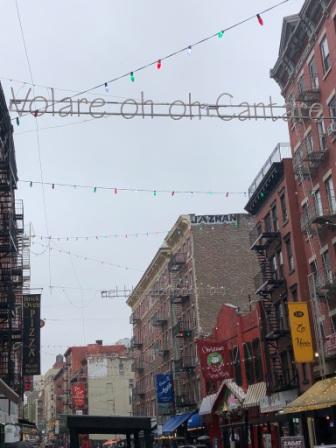
Next day, Monday May 4th, is a day off, and of course, it tips down with rain!  Not until I’ve walked some of the wonderful, leafy High-Line, though; after which I wend my way to Little Italy – where the words of ‘Volare’ are spelled out in little lights, strung across the streets.  I dive into a recommended restaurant, Zia Maria, and have a delicious lunch while watching the rain bucketing down outside.  At least the temperature is cooler.

Continue reading

Before the House Un-American Activities Commitee (well, kind of )

Scene:  a forbidding committee room arranged in the style of a courtroom.  A stern official – seated – is firing questions at a British actor/playwright – who is standing in front of him.

‘It has come to our attention that an audience member at a performance of your play The Error –

‘Mistake, your honour.’

‘Pardon me?’

‘The play is called The Mistake.’

‘Don’t interrupt again.  An audience member at a performance of your play deemed it to be un-American.

I must therefore ask, are you now or have you ever been a playwright who depicts the sufferings of innocent victims of war?  More specifically, a playwright who writes about the victims of American atomic bombs?  A playwright opposed to war in all its forms and to the military-industrial complex?’

‘Yes.  I am.  And I stand by everything I’ve written.  But it has never been my intention to create a work that was un-American.  I have tried to portray all sides of the debate, of the conflict.  Fairly.  To give every character the opportunity to vigorously make their case.’

But I’m getting ahead of myself.  Again.  Back to my first full day in New York City – Monday April 21st – before we’ve even entered the theatre which will be our home for the next three weeks.

I find myself singing as I walk the streets downtown with our director Rosamunde Hutt, who flew in the day before.

Continue reading

With the Quakers in upstate New York

April 18th.  You learn something new every day.  Today I learned that ‘Nazi Democrats are all low-lifes’.  This was painted on a large board outside someone’s  house on a quiet country road near Old Chatham in upstate New York.  Joseph, our host and prime organiser for our two performances in the area on Good Friday and Easter Saturday (would anyone come? I wondered.  Wouldn’t they all be on their Easter break, with family, or away visiting relatives?)…anyway, Joseph was driving us in his pickup truck (another story) to Patrick, a friend of his who, over time, has been a dancer, actor and is also a playwright – who happens to have also written a play about Hiroshima – something he’s been working on and a subject he’s been obsessed with for far longer even than myself.  Since the age of ten, he tells us.  (He’s now in his early seventies.)

Out of the truck window I see an elderly couple – who look so sweet and charming – walking up the hill past the sign.  ‘Joseph! Are they a couple of Nazi Democrats, by any chance?’

He chuckles. 

Continue reading

Performing in Amish Country – (but not for the Amish).

We leave South Bend and Notre Dame University and on Monday morning (April 14th) head for Chicago Airport – where we will fly east with all our bags and baggage.  

First class on the internal United Airlines flight is only marginally more expensive than a regular ticket – so I treat the three of us to a little more legroom (plus superior snacks) on the two hour journey and for the first – and probably last – time in my life, I sit in seat 1A: first on and first off.  A small treat for me after all the stresses and strains of dealing with my three large cases – one personal and two for the play.  

We’re met at Harrisburg Airport by the wonderful H.A. Penner, my host here previously in 2018, and Lydia, both of whom help us with our luggage into the van they’ve commandeered for three days.  We head to Lancaster County, our base for two performances in two churches – and the heart of Amish and conservative Mennonite country.  

Our hosts are Mennonites too, but they are progressive, liberal ones, with no qualms whatsoever about using cars, cellphones or electricity.  

Continue reading