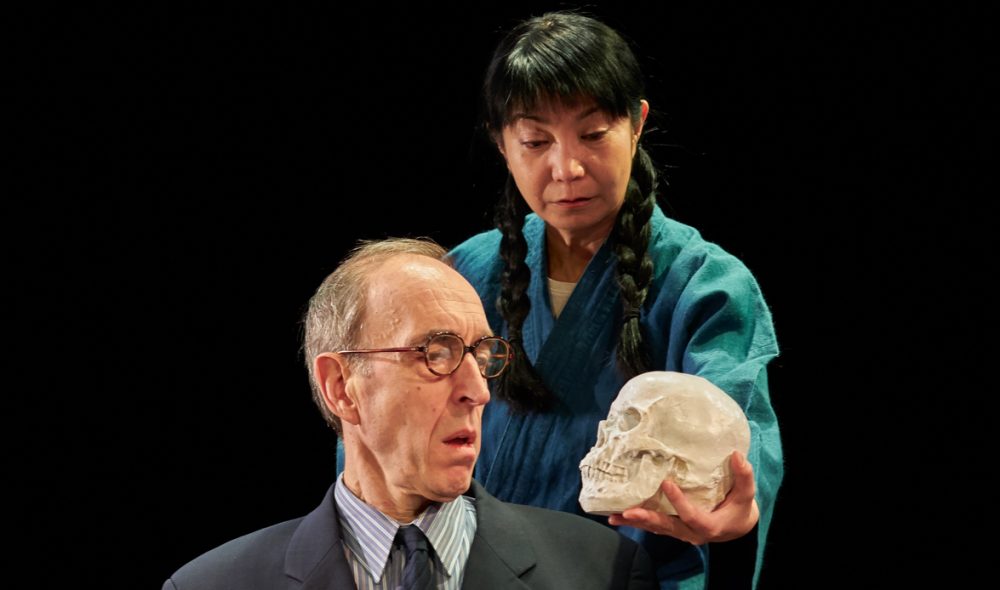
Wakeful, during my second night in Hiroshima, I recall more poignant details I learned in the last couple of days from Toshiko Tanaka, atomic-bomb survivor. When she gave birth to her first daughter, Reiko, Toshiko’s husband arrived at the hospital looking pale and worried. He counted Reiko’s fingers and toes and when he found that she was born without physical defects he said, ‘Thank you!’ Toshiko realised that, out of love, her husband had never said anything, but had always been secretly concerned about the possible after-effects of the atomic bombing. In my play, Shigeko, suffering from radiation sickness, seriously contemplates whether she should have children, in case they too, like her, will have been ‘contaminated’ by the bomb. The atomic bomb not only wreaked havoc on this two fateful days, August 6th and 9th, but spread its sinister tentacles down the generations.
Eventually, day breaks and I realise it’s October 1st – a new month. We now have only three more days in Japan.
A few years ago, Hiroshima University moved to a campus nestling amidst beautiful tree-clad hills and mountains about an hour’s drive from the city. Their peace studies department were keen to host a performance of The Mistake while we were here, but when they realised a couple of months ago that it would be a bilingual version, they hesitated. They were concerned about the majority of their international non-Japanese speaking students. ‘Could you do it all in English?’ they asked.
Nope. Not possible, I’m afraid.
We’d have performed the bilingual text less than 24 hours earlier and to switch versions – particularly for Riko to switch versions – at such short notice, would be one challenge too many.
Junko, who was organising our Hiroshima performances, then asked me about my solo piece, The Priest’s Tale, in which I enact the story of a European atomic-bomb survivor. Could I perhaps do that instead? It took me no longer than the blink of an eye to decide – yes! – I’d be thrilled to perform this other Hiroshima-related piece for the students.
It would mean having to pack my priest’s ‘dog-collar’, and a few other bits of costume as well as two or three extra props, in addition to everything else I was packing to bring to Japan. But my suitcases being so cavernous, somehow I’d cram everything in.
Would I be able to cram both plays into my less than cavernous brain, though?
Well, I’d performed The Priest’s Tale twice in early August, so it was still fairly fresh in my mind. And after arriving in Japan I made sure to run the lines in my head while on the way to visit temples or when queueing at the neighbourhood bakery for a couple of cream puffs.
This first day of October – when I’m due to perform the piece – is also the first day of term, ‘Commencement Day’, and as there are many other things going on at the University, my performance will take place at 5 pm – and not in a theatre or lecture hall but in a spare classroom. Not a problem. Tables are removed, chairs are arranged in semi-circles, I put on my dog-collar, then practise the moment in the play when the atomic bomb explodes, causing me to roll off a bench onto the floor, my shoes and clothes spinning into the air, as I manipulate (like a puppeteer) a small suitcase that flies in slow motion from one side of the room to the other. I then run through some cues with Maria, who has kindly offered to operate sound, while Riko has the day off to sight-see with her mother. At 4.45 pm, about thirty or more students and staff arrive to take their seats.

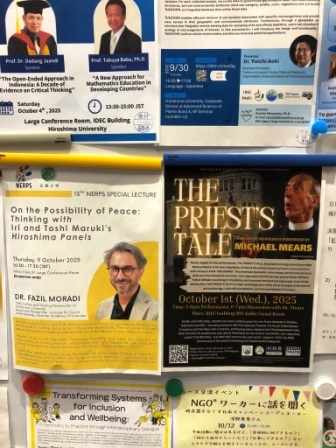
For some of them it’s their first day at the University, and it’s a bit of a shock for them to be told they will be attending a very unusual kind of seminar – a theatre performance at close quarters about a priest who survived the atomic bombing of Hiroshima.

We are now just awaiting our guest of honour – and here she is, Koko Kondo, atomic-bomb survivor, who having seen The Mistake last night, is now sitting in the front row of this University classroom, a few feet away from where I enact yet more events from that apocalyptic day in August, eighty years ago.
Thankfully, I don’t forget the words, I remember all the moves; the small suitcase, guided by my right hand, flies miraculously through the air, and the tale of Father Wilhelm, German Jesuit priest, unfolds.
After the performance and before our Q and A session, at which Koko will share her own experiences, two students approach me to thank me, saying they had never been that close to an actor performing before today. ‘We were right there with you in every situation, every moment of the priest’s story. There were times when we could barely breathe,’ they tell me.
I am reminded again of the power and effectiveness of simple storytelling – performed with conviction and nothing more than a few objects; where the audience fully engage their own imaginations, helping create the world of the play alongside the performer.
Koko Kondo was just ten months old when she survived the atomic bombing. She recounts how as a child, when she began to learn the facts about what had happened on that August day in 1945, she began to harbour a deep desire to find the men who had dropped that bomb and PUNCH them! Her father, Reverend Tanimoto, had been travelling to the United States, undertaking speaking tours of colleges and churches, to raise money to rebuild his church and later to help fund plastic surgery for some of the young women (the ‘Hiroshima Maidens’) who had been severely disfigured as a result of the blast.
In 1955, on yet another of these fund-raising tours, Reverend Tanimoto was surprised to find himself being ushered into a TV studio where he would be that week’s subject of ‘This Is Your Life’. (This episode of the programme can be found on YouTube – the account of the atomic bombing being interrupted for ‘a word from our sponsors’ – Hazel Bishop Nail Polish…) His family had been secretly brought out to the USA for the programme, Koko now being ten years old. When she saw that one of the guests on the show was Bob Lewis, the co-pilot of the plane that dropped the bomb, her anger instantly flared up. ‘I’m going to PUNCH him!’ she thought to herself. But when the co-pilot talked about his remorse (saying he had written in his logbook, immediately after the bombing, ‘My God, what have we done?’) and appeared to be tearful, Koko’s desire to punch him melted away. Instead she went over to him and quietly took his hand. Koko tells the students assembled here at the University today that this was a crucial turning point for her – setting her on the path of peace and forgiveness.
She then tells us how at one of her many subsequent talks, in schools and colleges around the world, relating this story of how her urge to PUNCH the co-pilot had melted away, one schoolboy made the comment, ‘When I raise my hand, I think of Koko.’
She couldn’t understand what the boy meant. You raise your hand when you want to ask a question. But it then became clear that this was a boy who was always getting into fights. What he meant was that now, when he raises his hand – in other words, to thump another boy – he will think of Koko and stop.
‘We can all make a difference,’ Koko encourages us. We can all stop and think before we let our fists fly, before we launch our drones, fire our missiles, threaten to use our nuclear weapons.

She shows me her old hardback copy of John Hersey’s HIROSHIMA, which features her father’s story but in which she is constantly referred to as his son. She tells me that when she met the author, the first thing she said to him was that he must correct this error – ‘I’m Tanimoto’s daughter, not his son!’ I wonder to myself if she’d felt like punching Hersey for this error…
A student, Patrick, asks Koko to talk more about ‘the journey of forgiveness’. He then reveals that he is from Rwanda – where, with its tragic recent history of genocide and savage tribal conflict, forgiveness is not a straightforward matter. Today, sitting with these peace studies students from all around the world, it becomes clear just how complicated the path to peace is.
At the end of the session, Koko thanks me for these two plays of mine that she has seen within the space of less than 24 hours. She encourages me to keep going. She herself is off to Rome shortly to speak at yet another conference, this time involving Catholics and Protestants. Koko is such a live-wire, feisty, funny, full of passion, it has been a real pleasure and inspiration meeting her.
Junko, Maria and I take a taxi back to the city and I allow myself another quiet evening of reflection.
Next morning, we are given a guided tour of the Peace Park and the Peace Memorial Museum. The museum is sombre and deeply moving; people walk through it respectfully, speaking with hushed voices.


There are black and white photos of the city before and then after the bombing; graphic images of victims and their injuries; a video display recreating the moment the bomb dropped and how it destroyed so much of the city.
In another room, objects that were recovered; children’s clothing; a child’s lunch box; a boy’s tricycle.

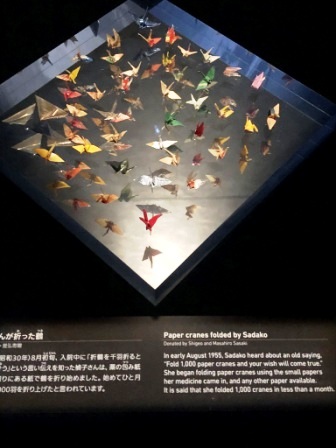
A number of Sadako’s exquisite tiny paper cranes are on display.
All I can think of is the waste, the loss, the futility. Pete Seeger’s lyrics come to mind… ‘When will we ever learn? When will we ever learn…’
Back out into the October sunshine, and it’s lunchtime. We are taken for a treat; ‘okonomiyaki’, Hiroshima-style. ‘Omelette’ doesn’t describe this wonderful dish, cooked on a hot plate right in front of us, by a woman who says she’s been doing this since she was eighteen, and will go on doing it until her dying day. The dish is scrumptious.
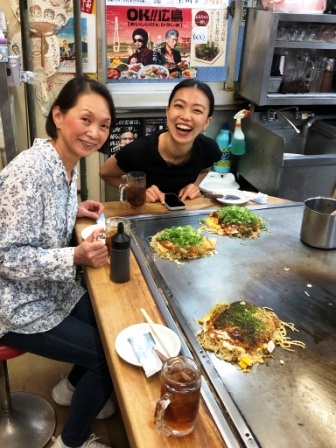
When we’ve eaten our fill, it’s time to say take our leave of Hiroshima City; we are collected in a minibus and driven to Takehara port to pick up the ferry to the island of Osaki Kamijima, in the Seto Inland Sea – and our final destination on this tour, the Hiroshima International Global Academy – where the next morning we will perform to the whole school, about 300 students and staff, in their cafeteria, which after breakfast will be swiftly transformed into an auditorium.

On the ferry, I feel my shoulders relax and a deep wave of contentment washes over me. Ahead of us and all around are countless islands; the scene is one of utter beauty; and when we reach our island we spend the first of our two remaining nights in the fabulous hotel we have booked. In a stunning location. Perched way above the sea. With its own ‘onsen’ (Japanese hot spring baths). And offering a superb banquet supper of the freshest fish you can imagine. The hotel is not expensive, it’s tremendous value for money – the only problem being it’s a heck of a long way from anywhere. But it’s the perfect place to complete our month in Japan.
Next morning at the school, we set up our props, and prepare to perform on the school’s raised stage at the far end of the cafeteria while three hundred students file in to take their seats – some of them a very long way from the stage. Two talented and helpful students have offered to operate the sound, under Maria’s supervision, and despite confessing to being very nervous, the two students carry it off brilliantly. Riko and I have to use every ounce of our vocal energy to compete with the noisy air-con and the clanking from the nearby kitchens preparing the students’ lunches, but all goes well.


Speeches of thanks are made, lunch is served, after which we have a long, leisurely discussion about the play and its themes with a dozen keen students. Everyone at the school has been so welcoming, so friendly; there’s a lovely vibe to the place; we learn that it’s a state school, but that the students board for months at a time. Soon it’s time to leave and we are waved off by the students we had been talking with and by members of staff, including the principal. They wave to us and we wave back for as long as we can see each other, as we are driven back to the hotel for our final night.
A huge party of elderly women has just arrived at the hotel – they’re from an agricultural group apparently and are enjoying a one night ‘reward’ break. Their laughter fills the building and fills the ladies onsen baths, next to the men’s onsen baths, where I float alone in the deliciously hot water gazing out at the sea as daylight begins to fade…
The ladies sound as if they’re having the time of their lives. Some of them looked very elderly indeed. But we too are having the time of our lives. Riko, Maria, Junko and myself sit down to another sumptuous fish feast (including a fresh seabass au gratin to die for), and then a final night’s sleep in Japan. This time tomorrow we will be on the plane home.
I wake in the morning and draw back the curtains to find rain and mist enveloping the islands. There is a melancholy beauty to the scene. I take an umbrella and head down to the beach for an hour or so, before we are due to depart.
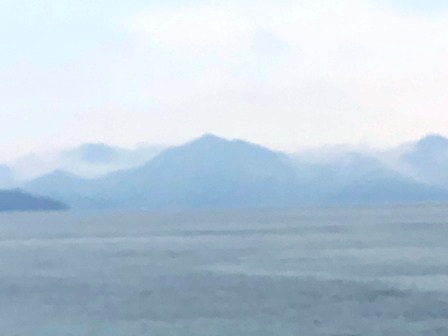
It feels as if we are in paradise… this Inland Sea studded with countless green islands folding in and around each other, mysterious wreaths of mist lodging in their hills and mountains, the sea hypnotically calm. Someone said to me before we left for Japan, ‘If you stay on an island in the Inland Sea, you will never want to leave.’ They were right!

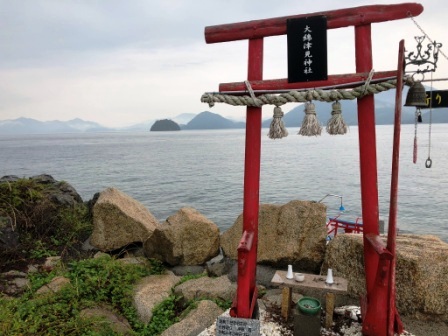
I walk further along the beach and find a path leading to a small shrine at the edge of the sea. It’s all so ineffably beautiful.
I feel sure we will come back to Japan again with The Mistake – there are so many places still to explore, so many places we want to perform the play in.
I approach the little shrine, ring its bell, drop in some coins, then bow my head, offering up heartfelt gratitude for the last 28 days. Unforgettable, exciting, deeply moving days, filled with so many new friends and connections.
Thank you…
Thank you…
Thank you…
 Michael Mears
Michael, this is wonderful, and your tour has been wonderful, and I am full of wonder at your work.
Kenn
LikeLike
Thanks again so much, Kenn, for your support and encouragement! I do hope we get a chance to see each other again before we’re too ancient…(though I know that ‘age will not wither us…’)
LikeLike
IDear Micheal,I wrote you a long deta
LikeLike
Hello there, your message was incomplete – ‘Dear Micheal,I wrote you a long deta ‘
Please try again? Thankyou!
LikeLike
Dear Michael,
l am 91 and dyslexic, which explains why l am so inefficient with my iPad! I spent very long time writing a very appreciative email which took me an age to write and l couldn’t face doing again! That is what the apparently incomplete email was explaining! I know that l said that I do hope that all the emails and photos are going to be made into a book. I want a copy please. I have seen your show, ( can not remember when or where , but l live in north Wales 25 miles from Bangor.)
As a Quaker and a life long pacifist, my father’s elder brother was the first CO to dye in the First World War as a result of his treatment. Look up Walter Roberts on line, but some of the information is not correct, l so applaud what you are doing.
Many thanks
Siw Wood.
LikeLike