Before we reach Hiroshima – the city that I feel I’ve lived in for much of the last decade, but a city that I’ve never actually visited – we have two other destinations. In my case, Nara and Tottori.
It was hard to fill every week of this month-long tour with performances, so we now have two spare days before travelling to Tottori City in western Japan where we have been invited to perform at the Bird Theatre Festival. Riko spends the two days visiting her family in Osaka; Maria stays with family in Tokyo, whereas I have been thinking of revisiting Kyoto – which I last saw twenty five years ago on my only previous visit to Japan, with the Young Vic Theatre Company when we were performing Hamlet.
But Maria nudges me towards Nara, the ancient capital of Japan. ‘If you like temples and shrines, you’ll find some beautiful ones there.’ So that’s what I do – head south on the Shinkansen bullet-train to Nara for two days.
‘On your way to the temples, watch out for the deer,’ Riko advises me. ‘They’re everywhere and if you’re not careful they’ll eat your food.’

My hotel is small but provides me with a decent-sized room, large enough to swing that proverbial cat in, and it’s located right next to the vast Nara Park – which indeed is full of roaming deer, of all ages, and all very docile. Mostly. Two deer with serious-looking horns lock them briefly in combat. There are elderly ladies selling ‘deer crackers’ everywhere, and signs saying ‘Do not bring deer crackers into the temple.’
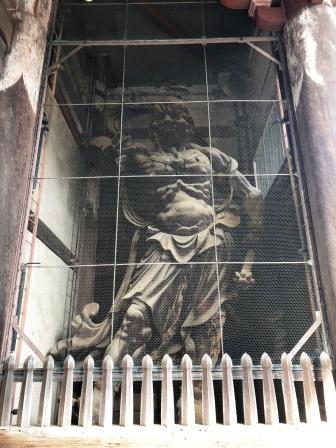

I have a couple of hours before sunset so I head to the Todaji Shrine, passing by statues of scary-looking ‘protectors’ at the entrance; then on into the shrine itself – where I am greeted by the Great Buddha, the largest statue of the Buddha I’ve ever seen.

Made of copper, it’s forty nine feet high and towers over all of us onlookers and worshippers. I don’t see any signs here saying ‘no photography’, so, after bowing my head, with due reverence I take a few photos, then move round the shrine contemplating the Buddha from all angles: the huge head, the large hands – it’s all pretty breathtaking.
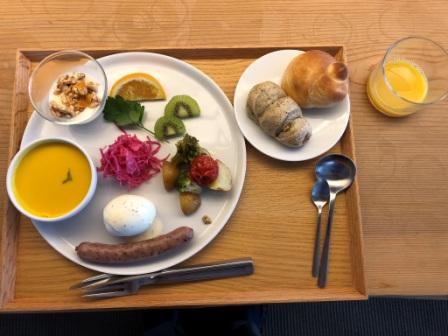

Next morning, after a ‘western’ breakfast at the hotel, delivered in the most beautiful Japanese style, I set off past the deer – deer on the pavement, deer in the flower beds, even a deer in the road on a zebra crossing no less. (Why did the deer cross the road? To get to the other side?) Speeding cars slow right down even though the lights are green and it’s their right of way. The deer in Nara are considered sacred – revered as ‘messengers of the gods’ in the Shinto religion.
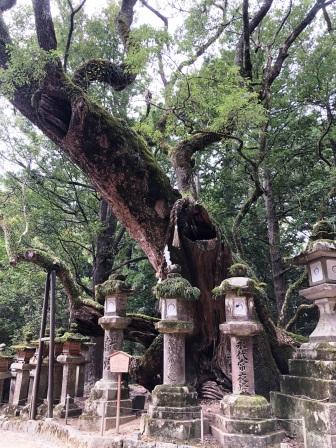
I walk along a slowly-rising path lined with hundreds of stone lanterns through beautiful ancient woodland, to the next temple I plan to visit – the Kasuga Taisha Shinto shrine, with its vermilion pillars, and where there are two hundred wisteria trees, which must look stunning in the springtime. This is considered one of the most sacred sites in Japan, but today the inner sanctuary is closed because of a ceremony – which looks to me as if it involves the induction of novice monks. It’s still a serenely peaceful place to be in and walk around, with thousands of cicadas chirruping in the trees, and the entrancing song of birds I’ve never heard in the UK, providing a magical soundscape.

After heading back through the forest (where I once more feel ‘bathed’ again) I visit an exquisitely beautiful landscaped garden.
Next, I want to see the 5-storey pagoda – but, drat! It’s being refurbished and is completely covered up. So I make do with visiting a 3-storey one instead.
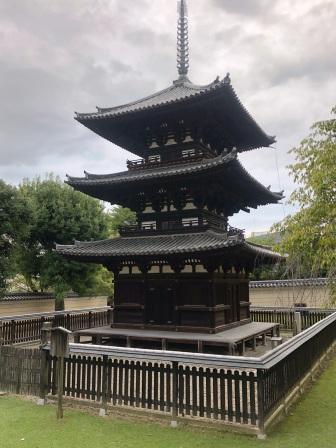
The nearby Kofukuji Temple is open, and in its Eastern Golden Hall I see some sculptures which really do take my breath away. There are signs saying ‘no photography’ here – so all I have is their leaflet which only has a few not very satisfactory photos in it…

There’s one sculpture in particular – of an elderly man, unwell, a lay preacher and follower of the Buddha, who sits erect, quietly dignified, looking out at me across the span of eight hundred years. Yes, eight hundred. I stand transfixed before him and time seems to stop. The moving detail the sculptor has captured, the realism of this portrayal compared to the other statues and sculptures nearby which are more devotional or symbolic is a potent reminder to me from the distant past to keep honing my own craft – to keep looking for the details, the truthful revelatory details in portraying human life both as an actor and as a writer of plays.
Next day, I have booked a late morning train – or rather 4 trains – to take me to the small city of Tottori to meet up again with Riko and Maria. Which means I have just enough time to visit another temple – a small tranquil gem tucked away in the side streets of old Nara town.

There’s hardly a soul there and I take time to relish the silence and peace. There are placards describing different types of meditation – one being the Full Moon meditation where if you manage to visualise the full moon then possibly, just possibly, hidden treasures may reveal themselves.
I sit in delicious solitude and try it. Of course, the full moon has many other connotations – some linked to lunacy and madness.
And the question floats into my mind, as I try to visualise the full moon – am I crazy, am I not a little bit insane, to have embarked on these two complicated tours abroad this year?
We have sent the prop suitcases ahead with a transport firm, so I only have to lug my own massive personal suitcase out of the taxi and on to the first of my four trains – requiring three changes – to Tottori. All four are on time to the minute which is pretty impressive.
Tottori is a small city but Shikano, where Bird Theatre Festival is located half an hour away, is positively rural. We are met by our translator Haruna, who drives us alongside the ocean and through gorgeous green wooded hills and small mountains to get there.
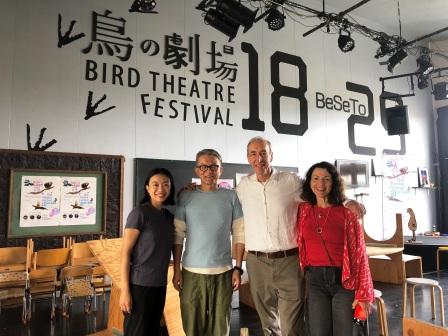
Bird Theatre has a lovely building with a cafe, outdoor spaces, a very special gift shop, and an excellent 200 seat theatre. Makoto Nakashima, the charismatic and irresistibly charming artistic director, meets us and shows us around.
‘But you are not performing here,’ he informs us. ‘You’re a ten minute walk away in the City Hall…’
Where there is an eighty-seat theatre, the Assembly Theatre, specially kitted out for the Festival, with two large functional rooms at the back to serve as dressing rooms.
The crew working with us are utterly delightful and so keen to be helpful but they don’t speak a word of English. I throw some of my pidgeon-Japanese around, eliciting smiles and laughter, especially when I keep complimenting their work with ‘Subarashi!’ (‘Great! Fab!)
Maria transmits our lighting and sound requests to Haruna who then translates them to the crew. It’s quite a slow process – and Haruna has to search hard for words, as she has no knowledge of theatre technical terms like upstage, downstage, focusing the lights, slow fade, coming in tighter with that sound cue, etc.
She’s exhausted by the end of the day but has done a wonderful job.
‘Subarashi!’
We are very grateful to have her with us. (Riko of course speaks Japanese but she needs to focus on her performance.). We have a very good dress rehearsal and then on Saturday 27th at 4.30 we will have our first of two performances.
On my way to the venue I walk through the little town of Shikano, pinching myself – I am about to perform my own play in western Japan! How did this happen?
And I ask myself, is this the most rural venue ever on our various Mistake tours?
I pop into the restaurant next door to City Hall and fortify myself with delicious soba noodles – while contemplating the fact that today is International Day for the Total Elimination of Nuclear Weapons.
I then head to the venue and while warming up look out at the empty rows of seats – which have no backs. A bit like the old Bush Theatre in London. But it’s not long before fifty or so Japanese theatre-goers take their place.
The applause at the end of the performance continues for some time after we have left the stage. Riko has started changing but I say we should really go back out again.
The applause in response to when I speak in Japanese at the curtain call, expressing my hope that we all continue to work for a world free of nuclear weapons, is very moving. After the show, we hasten to catch a Japanese company performing in the main theatre – and then it’s party time!
The four companies performing this weekend are feasted by the Bird Theatre Company but are also expected to ‘do a turn’.
We were only told about this the day before and with much else for us to think about, I offer to do the turn and let Maria and Riko sit back and watch. I settle on singing ‘Yellow Submarine’ – with silly goggles, makeshift periscope and a banana doubling as a miniature submarine. Everyone knows the chorus and it goes down very well, I’m relieved to say. I also sing my own new lyrics to ‘Give Peace A Chance’.
‘Everybody’s talkin’ ‘bout
Ukraine, Gaza,
Putin, Netanyahu,
Trump bein’ rude
At the United Nations,
Wars in Africa,
Destruction everywhere…
All we are saying is
Give Peace A Chance…’
The whole of the mainly non-English-speaking party-goers join in the chorus as Riko and Maria hand out peace cranes…
It’s been a truly ‘subarashi’ day but I’m now shattered and can’t wait for my bed. In my tiny room. Very like being on an actual submarine.
When I wake in the early hours, I think about John and Yoko, all the efforts they made for peace. But wars still rage.
As for my modest 80 minute play, what hope can I have that it will effect any change, performing to just a few thousand people at most over these various tours?
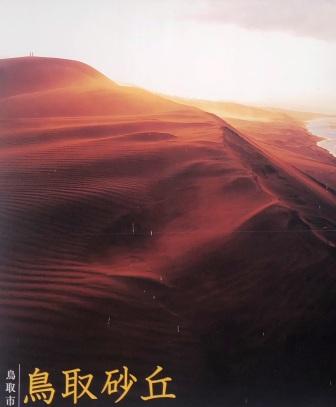
Tottori is famous for its nearby sand dunes, but I have no time to visit – though Riko dashes there in the morning and says they are sensational. I have to make do with taking a picture of a poster. Our second and final show here, to a deeply attentive and completely silent audience, goes extremely well. It’s then time to pack up, say goodbye and bow half a dozen times or more to our glorious young crew and to our translator Haruna.

A twelve year old Japanese boy was in today’s audience – Maria spotted him writing feedback afterwards, leaning on the front of the stage.
His mother ushers him onto the stage when we come back after changing our clothes as he is very keen to express to us how much he had loved the performance. Someone translates. ‘It’s the best theatre show I’ve ever seen.’
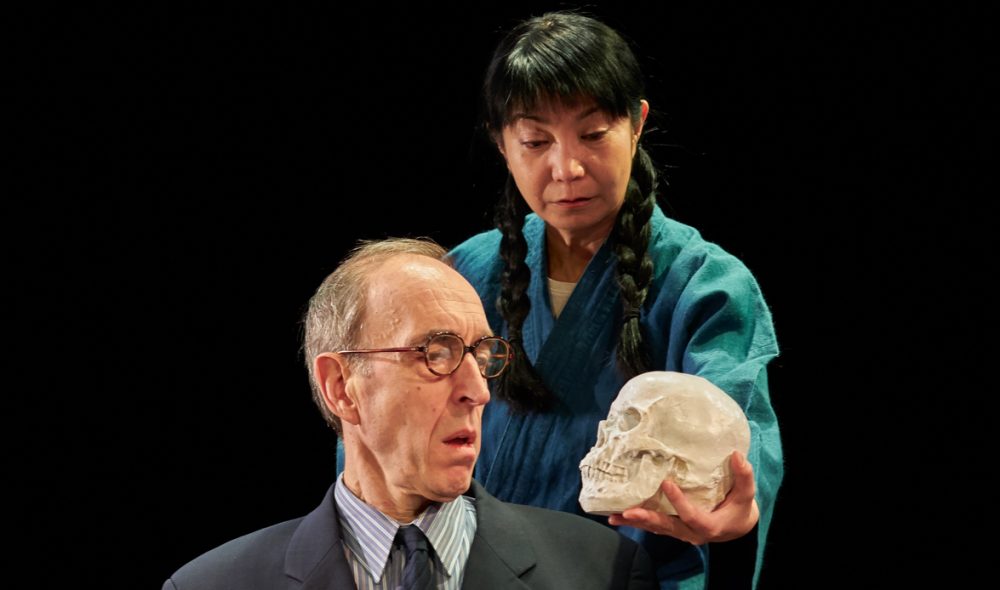
He takes a close look at our props, the model plane, the skull, the uranium sphere, takes some photos and then tells us, ‘This play made more of an impact on me than our school visit to the Hiroshima Peace Museum.’
Wow.
When we read his written feedback later, it says, ‘It’s time for the younger generation to take an active role in freeing the world of nuclear weapons.’
Again, wow.
The Oppenheimer film – which didn’t reference the Japanese experience on the ground in Hiroshima at all – reached millions of people, whereas The Mistake can only reach a few thousand at most. But after this boy’s reaction today?
Perhaps this play and our modest small-scale production can have an effect after all. Perhaps that twelve year old Japanese boy will grow up to become a significant campaigner in the struggle to eliminate these terrible weapons once and for all.
Who knows?
Whatever may happen, all I am saying is give peace a chance…
Thanks to all who have supported this venture.
If you would still like to make a donation, please click here.
Thank you
 Michael Mears
Brilliant one. X
LikeLike