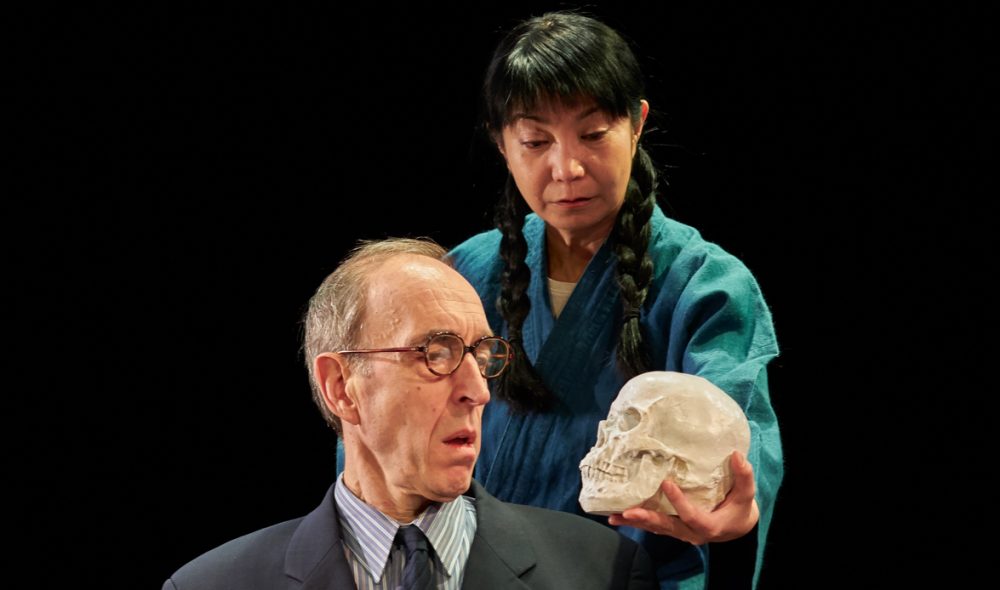
So, it’s been an eventful few days – but all in a good way. Well, apart from the ‘stuck up a cul-de-sac for half an hour in a huge taxi’ incident. (Did that not make the World Service news?)
On Sunday afternoon we had our second performance of The Mistake for a much quieter and more solemn audience than the previous day.
This was followed by our first Japanese Q and A with the help of an interpreter. Some really interesting and absorbing questions, one person wondering why we hadn’t given Shigeko, the 1945 atomic-bomb survivor, a Hiroshima accent? Good point! In fact, the highly skilled translator of our bilingual script, Yojiro Ichikawa, had asked me initially, ‘Shall I use Hiroshima dialect for Shigeko?’ and I’d said, no – thinking that that might be one extra challenge too many for Riko to take on. But the audience member now went on to say, that having Shigeko played in Japanese without a dialect made her somehow more universal, someone we could all identify with. Interesting.
As in many other Q and A’s, I am asked what gave me the idea for the play – and so I recount my story of reading two interviews in the Guardian newspaper twenty three years ago (the yellowing copy of which I still have and show to the audience), an interview with the pilot and an interview with a survivor – and how I began to wonder whether that might work dramatically…if the descendant of a survivor sought out the pilot in his old age to ask him some tough questions… and thus the seeds of The Mistake were sown.
Sunday evening we were free to relax and next day, Monday 15th, it’s a holiday in Japan, ‘Respect For The Aged Day’. We have an event at the theatre all afternoon – first a Tokyo-based Improvisation group movingly exploring stories of people in Hiroshima just before the bomb was dropped… followed by a short break for the completely full house, while we set up our props, and then it’s The Mistake…followed by another Q and A.

During the play, at almost the halfway point, the blackboard, which has images on both sides and which gets flipped round a number of times, came out of its socket on the left side! Just when Riko has an emotional section of dialogue. Fortunately, I am facing upstage at this point, standing next to the board, and have nothing to say for half a page – which allows me to think quickly. We need to sort the board if we’re going to pull off our coup de theatre later in the play (spoiler alert) when the board magically becomes the wings of the Enola Gay.
My next line is ‘Stop!’ and so I say it twice. Once in character, then once as myself, and I continue – ‘Sumimasen, everybody- we WILL stop – just for a minute – to fix the board. Jalani! Can you help me, please?’ But she’s already there, by my side – and together we put the board back in its socket, tighten the screws and after some applause from the audience, we resume…
Live theatre, eh? There’s nothing like it!
After another excellent Q and A, many people patiently Q – sorry, queue – to offer more thanks and reflections.
Hitomi is a friend of Riko’s and a very well known actor in the theatre in Japan. She has much to say to me – that she was hugely impressed by the performance, that she has played an atomic-bomb survivor herself in a play and so felt deeply empathetic to Shigeko’s plight in The Mistake. She says that the line that really struck her, towards the end, was Leo saying ‘The one thing I could not do was turn back the clock…’ Hitomi says it’s so agonising that we can’t turn back the clock and prevent these appalling events from happening – but nevertheless we can’t give up, we have to keep striving for a world free of these weapons. Her passion is infectious.
Then a married couple speak to me. She sounds German. He is clearly American. They tell me that they were arguing about the bomb at breakfast that morning in anticipation of seeing the play.
He says that his father had been serving in the far East towards the end of the war, ready to invade and quite possibly die, if the atom bomb hadn’t been dropped.
So he had always been brought up to believe that dropping the bomb was crucial to ending the war and preventing even more loss of life.
He then looks at me and says, ‘But my opinions on that have been changed by watching your play today. It’s given me a lot of food for thought.’
I have so valued the reactions of Japanese audiences to the play thus far. But this comment from an American in Tokyo – well, it’s hard to describe how it made me feel. If theatre can open hearts and minds like this then it is truly doing something invaluable – especially in these ever-more fragile and fractious times.
After flopping down in the cafe next door to eat some supper and reflect on the day, I walk back to my miniature apartment, and am nearly RUN OVER by a cyclist on the pavement! – of which there are so many…so many more than in London.
Alas, I haven’t yet learned the Japanese for ‘Hey, it’s Respect for the Aged Day! Show some respect for an old guy, can’t you, on this day of all days! I might look sprightly, but back home I get the state pension, doncha know?’
That would be some sentence to master in Japanese. Perhaps I’ll learn it for a future visit.
This is the first time I’ve felt annoyed on the streets of Tokyo, the first time I’ve almost shouted at someone. I’m glad I didn’t though. I’ve mostly been so taken with the engaging friendliness of the Japanese people I’ve met thus far.
Anyway, I haul my aged disrespected bod up the four flights of stairs to my shoebox-sized room and flop down onto the bed – which is a decent-sized double. A single bed would have been more than enough and would have meant I could practice dance moves and yoga (and been able to swing a cat) without thumping my head on the door and bashing my feet against the legs of the bed.
The close shave with the cyclist is now a fading memory though, and so, no longer irritated, I drift off towards sleep, in readiness for an early start tomorrow – our first schools performance.
Not in the theatre however. We have to pack up most of our set and order a large cab to transport the suitcases and three of us in the morning rush hour traffic to the British School in Tokyo. Inevitably we have to leave the blackboard behind but hope the school can provide one we can work with.
Despite the traffic we make good time, and the driver draws up alongside the entrance to the campus half an hour early – only to then overshoot it, not being sure that it is the actual entrance. It is! It is! But too late – we are now back in the traffic and the driver does what seems a reasonable thing, he turns first left then first left again, and drives his substantial vehicle with us all crammed into it, down the narrowest side-street I’ve yet seen in Tokyo. He keeps going. Right to the end. Where he can go no further. It’s a cul-de-sac, a dead end, with no possible way of turning round. I feel my stress levels rising… we were nice and early and now… we’ll be lucky to be on time. The driver, who is incredible polite and very apologetic, now has to reverse all the way up the narrowest side-street in town – trying to avoid the elderly gentleman watering his plants, the lady on her cycle trying to squeeze past and numerous other obstacles.
Eventually, half a lifetime later, we’re out – and back into serious gridlocked traffic. A u-turn, more gridlock, then another u-turn and we’re back at the campus entrance. I unlock my jaw, ungrit my teeth, and we all make a dash with our cases to the school building. Oh boy. I could have done without that tour of the backstreets of Tokyo…

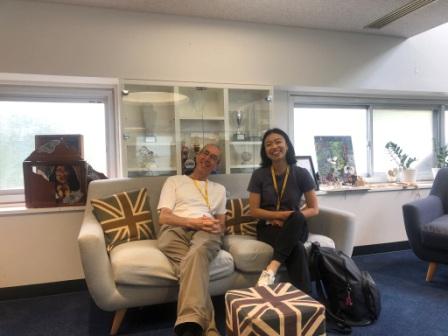
Anyway. We’re here. We are greeted and shown where the plugs and sockets are and so we set up. We are shown the blackboard (whiteboard) on offer – but sadly it’s a bit feeble, doesn’t flip, nor does it roll easily on its castors. Not to worry. We’ll create the plane without a blackboard.
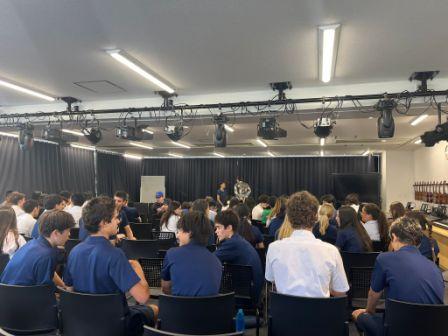
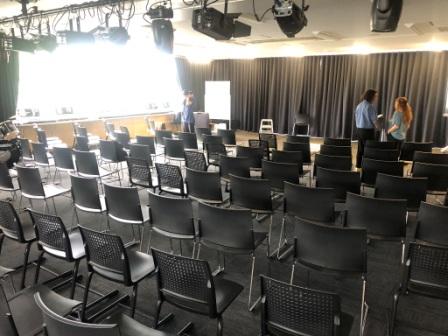
We’re in a brand new drama and music studio space, full of keyboards, a grand piano, a drum kit and a row of ukeleles hanging alongside one wall.‘Hey!’ I say to the others, ‘why don’t we just forget the show and form a band!’

With carpet on the floor the acoustic in the room is dry and pretty dead. Not great for the voice. And the air-con is noisy. But the performance to about 70 of the school’s students goes very well.
Some staff are present including the Principal of the school, Ian, who is the reason we’re here. Many years ago he worked at a school in Norfolk alongside my best friend John, and when John knew about my plans for the play in Japan, it was he who suggested I contacted Ian. And so, here we are…
Ian reminds me that thirty years ago – yes, thirty years – I came to perform my first solo show at their school. That was the last time Ian had seen me – and seen me act. Where have the years gone, we wonder?
After the performance we stay in the music room for a swift lunch, then twenty drama students, who all saw the play, return for a workshop led by Maria.
The students have only just met us but they soon warm up and relax and after an exploration of character transitions – moving between two characters as I often do in the play – and after exploring many and various imaginative uses for a walking stick and other props, we then set up two scenarios.
In the play just two of us, Riko and myself, plus Claire Windsor’s atmospheric soundtrack, create moments like the explosion of the bomb or the chain reaction experiment in Chicago in 1942.
But what if we had a cast if twenty? The students choose a persona and an activity they might be involved with on a Monday morning in wartime when the all-clear has just been given – and then react to the sound of the explosion when we play it to them. Some of them freeze, glued to the spot; others start collapsing in slow motion. To we onlookers, it’s already a very effective tableau.
Next, they all become scientists reacting in different ways as the chain reaction experiment progresses – the tension in the room mounting as the experiment becomes increasingly dangerous.
The students have become more and more trusting as the session has gone on, open to suggestion and exploration – and there is a beautiful solemnity about their work as they create these two different tableaux – proving that there is an infinite variety of ways of staging events and scenes…all that is needed is imagination.
Don’t get me wrong – I really like film, I really like television – at its best. But I love theatre – there’s nothing like it as far as I’m concerned. With a few simple props, some powerful words, talented and daring performers and a generous dollop of imagination from both performers and audience, much magic can be created. Rough magic, to be sure, but magic nevertheless.


[like] TORU KATAOKA reacted to your message:
LikeLike