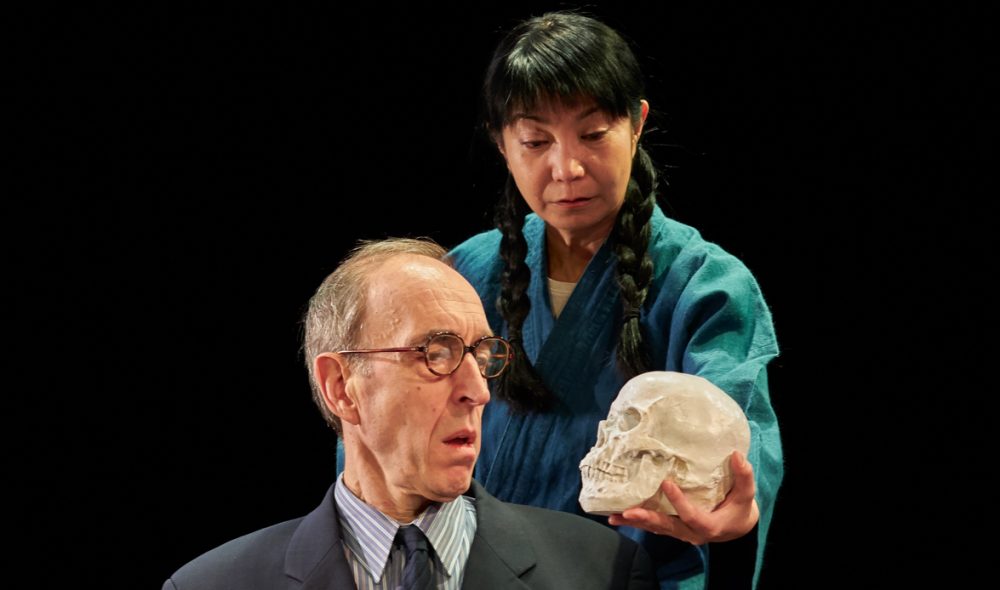
‘I’m So Grateful…’ ‘We’re So Grateful…’
Those words are ringing in my ears as I walk back to my tiny apartment in the balmy Tokyo evening, after our first ever bilingual performance of The Mistake – indeed, our first ever performance of the play in Japan. ‘This play – so important.’ ‘Very important, this play you have written.’
‘In Japan we feel that only Japanese can understand all the feelings around the atomic bomb. But your play shows that a western person has understood those feelings and understands what the people in Hiroshima suffered.’
This is all incredibly humbling, as you can imagine, but also a real affirmation of what I hoped for in bringing this play to Japan.
Hang on, I’ve skipped a few days.
Two days earlier, we meet our young, energetic and oh so enthusiastic team at the theatre, for technical rehearsals. Riko takes charge of marking up the floor with red tape to suggest a squash court – where the chain reaction experiment (a scene in the play) took place in Chicago. She is a perfectionist, takes her time and marks it up beautifully. Then there are the subtitles to sort out, which will be projected on the back wall above the blackboard used in the play.
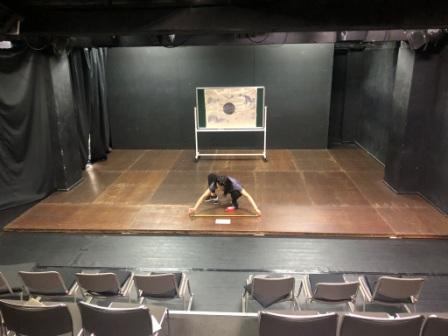

Oh yes, the blackboard – which we couldn’t transport to the US earlier this year, so had to source boards there, and which we couldn’t transport to Japan either. So a board has been purchased for us here – which however is not very high. The reason being that Japanese people are not generally 6’ 2’’ tall (as I am). So I will have to stoop a little in performance to chalk up my equations (he stoops to conquer?)
Talking of stooping, there isn’t too much space backstage – so I offer Riko the main little dressing room area while I elect to take what might be the smallest dressing room in the world – well, certainly in my career. A cupboard under the stairs, you might describe it as. But it has a curtain and affords me a little privacy. Might need to see an osteopath though, to straighten out my back, once I return to London.

Just before lunch, Riko and I are interviewed by Hisanobu Ito for the AKAHATA newspaper – the daily paper of the Japan Communist Party – a party not as extreme as it sounds, however. In fact, Ito-San interviewed me in London in 2019, not long before I was planning to produce the play for the first time – until a certain world pandemic put paid to those plans. He shows me some recent interviews he has done – and there, staring out of the paper at me, is the face of Jeremy Corbyn – who visited Hiroshima in August. (And who was due to see the play in New York earlier this year and be our guest at a talkback – until he had to cancel, unfortunately.)
At lunch, I jest to Maria that I still haven’t found my local neighbourhood bakery nor those seemingly mythical cream puffs.
We head back to continue work on the play and, during the evening supper break, I go to the cafe next door for some comforting pasta.
When I return, Maria presents me with a beautiful cardboard box.
‘A gift,’ she says.
‘What is it?’
‘Open it and find out.’
I do – and OMG!!!
Chou cureemu!
A magnificent-looking ‘cream puff’!
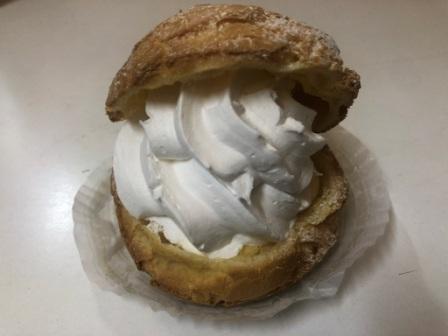
‘Where?’ I stutter. ‘Where, Maria? Where did you get it?’
‘I’ll show you on the way home.’
I cannot resist it and this seems an appropriate dessert to follow the pasta I had for supper.
And oh boy. It’s not mythical. It’s real.
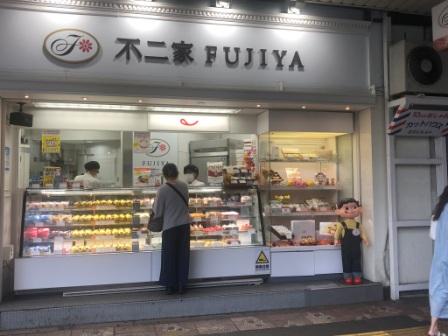
On the way home at 10pm that evening, Maria shows me the elegant shop on the corner near the station where she bought it from. ‘Temptation Corner’ I christen it…
The next day, Friday, we have our first dress rehearsal – with many a small hitch, with the Japanese dialogue, the timings of the subtitles and various other issues – but nothing major. By the way – did I mention I am speaking Japanese in three short scenes? Just to give myself an extra challenge. As if I don’t have enough to think about. Every day I work on my Japanese lines. I want to sound more than just ‘passable’. But it’s not easy acting in another language! Which makes me marvel afresh at the task Riko has taken on so valiantly, by being involved with this project first in its English and now its bilingual incarnations.
A good night’s sleep follows in my chilly little fridge/apartment and before I know it, it’s Saturday. September 13th. Opening night.
I’m not sure who the lady is on the large poster outside the theatre entrance – or why she seems to have much bigger billing than we do…

Anyway. Fifty people packed into this small venue feels very much like like a full house.
There is much laughter and chatter from the audience as they come in and take their seats. I hear many a ‘konnichiwa’ and ‘konban wa’ in greeting, as I stand in the little wing area offstage right. But the chatter and hubbub soon subsides to be replaced by complete silence. Total attention. No restlessness. No shuffling. No one needing to go to the loo. And thus THE MISTAKE (or ‘AYAMACHI’ in Japanese) takes its course.
At various points throughout the performance I have to get a grip and stop myself being overcome with emotion. Stay focused. Keep telling the story.
Towards the end it’s possible to detect very discreet snuffling, restrained tears, people swallowing their emotion. There’s no standing ovation. Simply applause that doesn’t cease.
I raise a hand and then make a prepared speech – in Japanese and English – using notes as I haven’t yet had time to learn it (but I will by the time we reach Hiroshima.) I make a joke – in Japanese – about my pronunciation, asking for forgiveness. When I end my short speech by saying that I hope we can all continue to work together for a world free of nuclear weapons, I feel myself choking up.
We leave the stage and Riko and I hug and high-five but after a while I realise … they are still applauding.
‘We’d better go back out again,’ I say to Riko.
There is no front of house or bar at Studio Actre so most of the audience just sit and wait for us to come out ten minutes later after we’ve wiped the sweat from our brows and changed.
People stand up and then start queuing patiently to talk to us – to express their gratitude… to share their emotions on witnessing the play. Ito-san, who had interviewed us, is there with his wife, who talks to me at length in Japanese about her responses to the play, her husband trying to keep up with her in translating for me. But I understand what she says when she tells me which line in the play struck her most powerfully…when Shigeko curses the Americans as devils, and her fiancé responds , ‘Hontono akuma wa senso nanndakara.’
(‘The real devil is war.’)
Is this evening one of the most quietly profound experiences of my 40 plus years in the theatre? I’d say, yes.
Our first night audience, predominantly Japanese, has clearly accepted the play with all its different perspectives, its sometimes distressing scenes and its undertow of sadness – accepted it in the spirit in which we have offered it.
Riko in particular is relieved to have received such a moving and positive response from the audience. After all, she’s the one carrying the weight of the survivor’s story in the play.
We’re all pinching ourselves. None of us can quite believe that we’re here, that we’ve done it, that we’ve performed the play in two languages for a Japanese audience in Tokyo. Afterwards we hug and high-five again, Maria joining in too, and all our wonderful young team join in as well, Jalani, Yuri, Zac, Chi, all sharing the joy and relief of an opening night that couldn’t have gone better.
After we tidy up, I walk home in the hot and humid night air, feeling a deep sense of satisfaction, of long months of hard work, my nose to the admin grindstone day after day, finally coming to fruition. I walk past ‘Temptation Corner’, which is now closed, of course.
But I smile to myself and lick my lips. The secret’s out. I’ve located my neighbourhood bakery!
 Michael Mears
Thank you so much for sharing the story of your time in Japan; very moving
LikeLike
A very moving account, Michael – I sit here wet-eyed. Massive congratulations
LikeLike
Thanks so much, Will (belated thanks!). I hope all is well…
LikeLike
This is epic Mike and fills my heart with joy and admiration for all you have achieved. Congratulations.
LikeLike