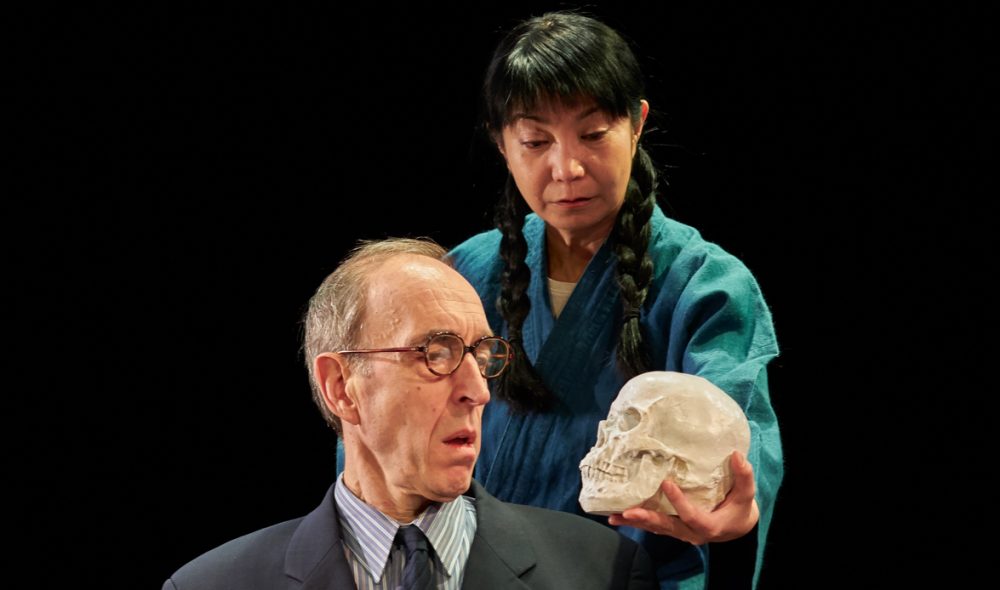
Chapter 1: One Step at a Time
Day 1 – Step 1… 5.20am up.
Step 2… 6.50… lugging three extremely heavy suitcases downstairs to the waiting minicab which can barely squeeze them in. The elderly driver is friendly and has a smoker’s cough.
Lots of traffic which then loosens up – like the driver’s cough.
At terminal 5, he helps me pile the three cases, a tatami mat, a silver case and my rucksack onto a pathetically small trolley. He is again friendly on saying goodbye.
Step 3 … trying to check in all these cases with BA and pay for the extra baggage. As I was unable to get the cheaper rate for doing this online (a complaint many users have voiced through Tripadvisor etc) and am a bit perplexed now by the self-checking-in system at the airport, a business-like and efficient BA official offers to check the bags in for me and sort payment. I thank her more than once for her assistance. First extra bag – £75. Second extra bag £155. Okay, I’d budgeted for this. She takes payment for the first bag.
I thank her again for her help. She then says she will waive the charge on the second bag. What?! She has softened a little – there’s even a hint of a smile. I thank her again – profusely. And realise I have just encountered the first angel of this six week adventure.
Step 4 … Security. Another official is announcing that we don’t need to take laptops etc out of our bags, we can just put the bag straight through the scanners. ‘So you can relax,’ she says. I say – ‘one doesn’t often hear the word relax at security!’ She laughs. Second angel?
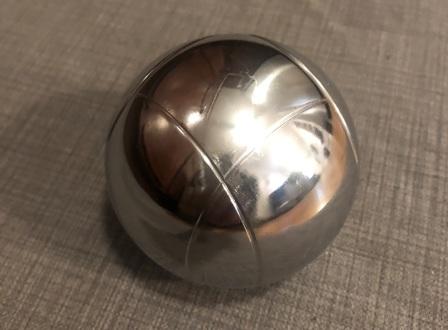
But wait – my silver cabin case is flagged up. It contains some of the props for The Mistake – including a silver boule we use in the nuclear chain reaction experiment. ‘You’ll need to open this case, sir.’ ‘Of course. I expect it’s a silver ball in there.’ It is. ‘What is it, sir?’ ‘Well, we use it in our play to represent uranium.’ ‘But it’s not actually uranium, I hope?’ ‘No, it’s from a boules set’. ‘Ah yes, I like playing boules.’ He scans it then with a smile waves me through. Angel number 3?
Step 5 … the flight to Newark International. Perfectly pleasant. And new cabin member Patrice – French obvs – makes me not one but two of the most perfect cups of tea I’ve ever tasted in a small paper cup while gliding along miles above the Atlantic. Plus he brings me not one but two mini-packets of chocolate digestives! All these angels out and about today!
Step 6 … we arrive in the USA!! Newark International.
AND we are allowed in! Uranium balls and all! A few awkward questions at border control – ‘Am I now or have I been a nuclear physicist?’ Nope. Just pretending to be one. Joking aside, it seems anxieties about presenting a play like The Mistake at this time were unnecessary… and so we head to baggage reclaim to get our cases, looking up at the board to check for our connecting flight to Chicago.
Step 7 … PANIC!!!! British Airways inform me it’s cancelled. They apologise for the inconvenience and offer me a consoling therapeutic chat with a robot – which I decline.
We decide to head for the other terminal anyway, where our flight was scheduled to depart – and I can’t get the trolley with my three cases onto the Airtrain. So I ditch the trolley but at the other end how will I manage three cases? There are no trolleys around. But Chris, a friendly American who can see the mess we’re in, spots a trolley way down the platform where we get off and hauls it back for us. Our first Angel in America. Then the official at the check-in desks tells us, no, the flight’s not cancelled. Phew! Plus she makes sure we’re not charged any extra for our many cases. American Angel number 2. (I guess British Airways were just trying, by panicking people with cancellations, to find some company for their lonely Chatbot…)
Step 8 … Chicago. Our pre-booked Lincoln Navigator eats up our suitcases in its huge trunk and Manny our excellent driver gets us to our Airbnbs without any fuss, where we can finally zzzzzzz…
Chapter 2: Martin Luther King and The Mistake
That’s a rather bold opening hook to this second blog of our US adventure. But I’ll explain shortly.
April 4th – Day 2 – Jet-lag. And a heating system in my otherwise lovely Airbnb that keeps erupting into life just when you least expect it – just when I’ve reached deep-state sleep. Will earplugs keep the noise out? No chance.
Okay. So I head out on my first morning in Chicago for a big breakfast at a highly recommended cafe – Lula’s in Logan Square. That helps. A cardamom bun to die for. Then a day full of nothing much – acclimatising, checking out where I can buy fruit, and reminding myself I’m not a tourist.
Day 3 – I’m a tourist. Heading for the wonderful Art Institute – wanting to see the famous Seurat painting that inspired Sondheim’s Sunday In The Park With George. On the L train, it’s rammed – jam-packed with hundreds of people. Are they also heading for the Seurat? No! There are placards and banners galore – it’s a ‘Hands Off’ (our democracy) protest downtown and it’s going to be really big, someone on the train tells me. We’re tempted to join them but our time is limited, so we wish them well when they all get off two stops before the Art Institute, leaving the train empty.
But the Art Institute isn’t empty. Justifiably.
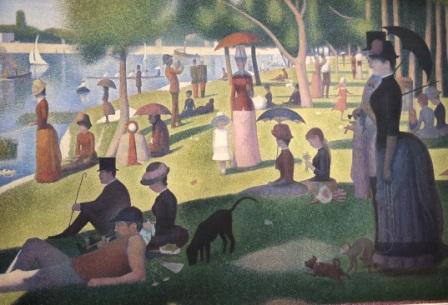
We stand for the best part of an hour in front of the Seurat painting. Magical. Later, some stunning Chagall windows. Then the wonderful painting ‘American Gothic’ – about which Riko suggests I could play the man. Hmm.

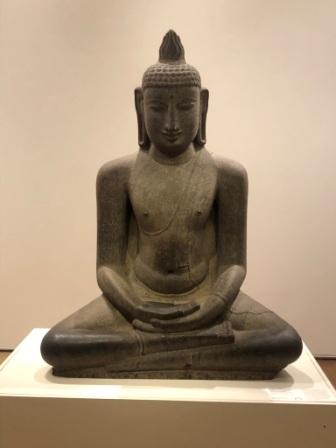
Not sure about the pitchfork. Also a beautiful 12th century Buddha – standing in front of which helps calm my pre-‘US premiere’ nerves a little.
Because I haven’t forgotten. I’m not here as a tourist. And the Martin Luther King connection? Oh yes, I’m coming to that.
Day 4 – a three hour Sunday afternoon drive to the peaceful little town of North Manchester, Indiana and its University – where I will give a ‘peace lecture’ the next morning and the day after that we will perform The Mistake. The town is so quiet that three cars in its Main Street signifies a rush hour. The evening we arrive we run the play, just the lines, in one of our student hall guest rooms. I then go back to my own room to run through my talk, my TED Talk- well, my Mike Talk. ‘The role of arts and culture in promoting peace and opposing war’.
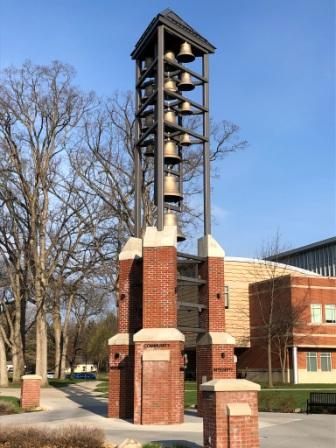
Day 5 – On campus there is a charming bell-tower. The bells are rung at 8 a.m. and 6 p.m. – the start and end of the day’s lessons – but they are also rung just before guest speakers give their talks – these particular talks always taking place on a Monday morning at 11 a.m. ‘Ask not for whom the bell tolls’ this Monday morning. I can tell you – it tolls for me! Gulp. No pressure then.
But thankfully the Mike Talk (and yes, I do use a mic) seems to go down well – though I keep reminding myself that the main reason we’re here is to perform The Mistake. And now I’ve got butterflies – even with all my years of experience. Not helped by the fact that in the evening we have a rehearsal in the performance space which doesn’t exactly go smoothly.
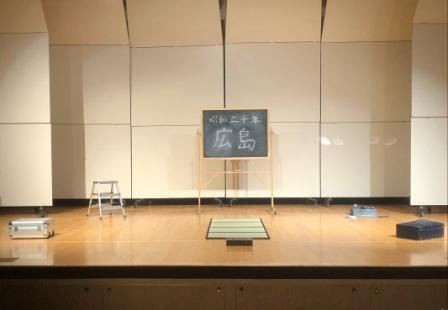
At least our props and set pieces look good on the Recital Hall stage.
Day 6 – today’s the day – our US premiere. The afternoon dress rehearsal goes much better – but the air con and heating in our guest rooms and in the auditorium is making my voice incredibly dry. I spoon honey down my throat, I spoon it into my tea, I drink so much water that when I relieve myself it’s like an elephant peeing – it just goes on and on and on…
But the performance? Phew. That goes really well. The butterflies subside. Manchester University hosts the oldest Peace Studies course in the world – 1948 – the same year the UN was established – and so it therefore feels right that this is the first stop on our tour.
There is a wide range of ages in our audience… from a 90-year-old lady who remembers air-raid drills in Indiana when she was ten, to a 22-year-old student who says that seeing the play has changed her.
Afterwards, Katy Gray Brown, professor of Religious Studies and director of the Peace Studies Institute and her husband David, plus Libby, the peace studies coordinator, treat us to cheese, fruit and many other tasty goodies in the little campus chapel! A very relaxed and informal first night ‘party’. Until the name of Martin Luther King enters the conversation.
Katy tells us that Manchester was the last university MLK visited to talk to students: just two months before he was assassinated in April 1968. We are pretty much speechless. Fifty years later, she continues, in 2018, those same students had an alumni reunion to remember MLK and his visit. And at that reunion they decided to set up a Peace and Justice Fund in MLK’s memory – to enable speakers, performers and other peace-related events to be hosted at the University. I was only slowly making sense of this. Katy spelled it out – ‘So that fund is the reason we were able to host The Mistake and your visit. You could say Martin Luther King is the reason you were performing here today.’ Myself, Riko and Maria immediately all have the same physical reaction – not butterflies but goosebumps.
Chapter 3: The Man Who Sets The Hands of the Doomsday Clock
So far on this tour, I’ve felt butterflies, goosebumps and now shivers down the spine.
Let me explain. You can spend so much time in emails and phone calls and Zooms – as I have, trying to pin down a particular venue for The Mistake in different parts of the US – and then all that effort comes to nothing. On the other hand, you can shoot off one speculative email – as I did just one month before leaving for the US – which was way too late – and get an immediate positive response and booking. Such was Chicago.
I had tried for months to get a performance in the Windy City to no avail. Various very promising options fell through late on – after I’d (perhaps foolishly) booked flights and Airbnbs. But that last minute speculative email of mine was to the Chair of the Department of Physics at the University of Chicago, Peter Littlewood – to which he responded that, yes, they’d love to host us on one of the dates we were in Chicago, in the Physics Department Lecture Theatre. I was beyond thrilled at the news.
So…Day 7 – after treating us to a fabulous breakfast at a lovely coffeehouse in downtown sleepy Manchester, Katy and Libby waved us off with our many suitcases and we began the three hour trip back to Chicago: Manny once again at the wheel of his voluminous (it needed to be) Lincoln Navigator. We were headed straight to the University of Chicago to set up and prepare for a 6 pm performance. We didn’t have much time to be ‘tourists’ but we managed a quick look around.

In the street nearby is a sculpture by Henry Moore called Nuclear Energy. First wave of shivers down my spine. The sculpture marks the exact spot where the first successful chain reaction experiment took place in 1942 – on a squash court beneath a now demolished football stadium – the experiment being an event portrayed in my play. However, on the plaque it only refers to its commemorating ‘the first controlled release of nuclear energy’. No mention of what the successful experiment led to – the atomic bombs that destroyed Hiroshima and Nagasaki. Hmm…

We head inside – past bustling physics labs full of students who look fiendishly intelligent.

On the walls of the corridors are information boards and pictures of some of the scientists I portray in the play – Leo Szilard, Enrico Fermi…more shivers. There’s a model of the original nuclear pile – which we symbolically recreate in the play with just a few items.
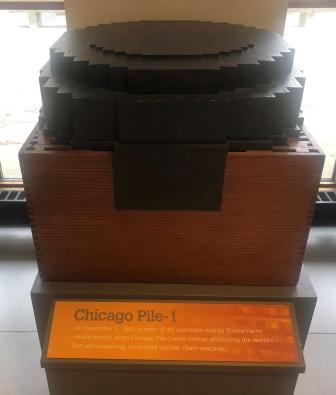
We’re pinching ourselves – are we actually going to perform the play here? It’s hard to take it all in.

An immovable desk on the right side of our performance space in the lecture hall makes it all quite tight and compact.

And the audio can only be operated from that desk – so the operator will be very visible throughout the performance. How to capitalise on this? Maria, our brilliant associate producer, has offered to operate the sound cues today and she agrees to my suggestion that she wears a spare white lab-coat we have in our props. Perfect!

At the back of the space are large blackboards covered with countless chalked-up equations. Should we erase them? I think not – as they add much appropriate atmosphere. But is there a mobile blackboard for us to use in the play? Yes! One has been provided – and it is magnificent! Large, heavy, steely and not easy to manipulate. But when it becomes the Enola Gay, the board tilting up to resemble steely wings, the whole effect is threateningly chilling.
We have to get a move on though, if we’re going to be ready for 6 pm. But we just about sort everything and then Riko and I retreat to our makeshift dressing room – a room off the hall with desks and shelves full of scientific and technical clutter. People start arriving. Scientists. Physicists. Some quite elderly and distinguished. Some non-scientific people too.
The performance goes very well and at every reference in it to the University of Chicago I feel more shivers down the spine. Riko’s line as a nervous scientist at the experiment – ‘It wouldn’t look good if we blew up Chicago’ – gets the biggest laugh of the night. Not that we’re performing a comedy, you understand. At the end of the performance some of the scientists are visibly moved. Emotional.
Daniel Holz, a younger physicist, cosmologist, astrophysicist, you name it, has agreed to facilitate the post-show discussion.
He has Brian Cox-like charm and good looks (Cox the scientist and British TV celeb, not Cox the thespian).
Daniel is chair of the committee of experts who meet each year to set the hands of the Doomsday Clock, which is a measure of just how much danger – how ‘close to midnight’ – those experts believe the world is in currently.
This January, the committee moved the hands a second closer – to 89 seconds to midnight – and I altered the reference to the Doomsday Clock in the play accordingly.
Daniel is passionate about his work, and passionate about alerting people to the dire threat posed by nuclear weapons. He says that as the play went on, it exerted a real grip on him – and that it was quite something witnessing in this lecture hall, this physics department, this University the scenes about the creation of the atomic bomb – and witnessing Riko enact so movingly the heart-rending story of an atomic bomb survivor.
Daniel expresses the view that his committee are in danger of viewing the Doomsday Clock as an intellectual exercise, and aren’t engaging with it emotionally, viscerally. He feels they really need to see this play – which he believes would have a real impact on them. He talks a lot about the need for making an impact.
We were honoured and humbled that such a significant scientist thought the play and production were so important, urgent, and extremely timely.
We pack our things away, Maria reluctantly hands back her labcoat (it was a really good look for her!) and I can’t leave the lecture hall without asking Daniel to quickly check my equations – the ones I chalk up on the board in the early part of the play. He laughs. ‘They were okay,’ he says, strolling over to the board to take a look at my work. ‘That one is correct and relevant – but this one?’ He can’t help smiling. ‘It’s correct but it’s not at all relevant to your subject matter.’ ‘Okay,’ – I have to stop myself saying ‘Sir’ – ‘But can you give me a new one then, and I promise I’ll learn it and how to write it?’ He says he’ll email me something.
Ah well, sciences never were my strong point…but I have to say it’s pretty cool having your equations corrected by the man who sets the hands of the Doomsday Clock.
When I drop a line of thanks to the Physics Chair, Peter Littlewood, who was out of town and unable to attend that evening, writes back saying, ‘As a physicist, the nuclear bomb is original sin. We have to live with it and learn from it. But it is important we do not forget it, and in many ways most importantly for our physics students to recognize the burden and responsibility they inherit.’
Chapter 4:Sports, Religion, Sports, Peace, Sports Sports Sports…

The huge campus of the famous US university of Notre Dame in South Bend, Indiana, is a place where Holy Cross Drive intersects with Frank Leahy Drive.


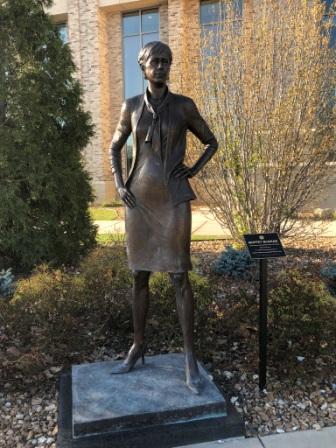
A place where you walk past sculptures of the same Frank Leahy (a famous Notre Dame football coach), then past a statue of the fabulously named women’s basketball coach Muffet McGraw (oh, yes) and then, after a short walk, past the huge, beautiful mural known as Touchdown Jesus.
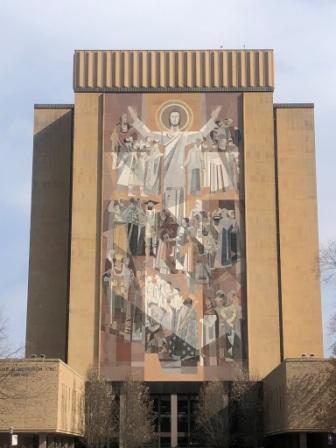
I kid you not. Jesus with his arms raised as if signalling a touchdown in American football. The mural is on the north side of the impressive Hesburgh Library – and is visible from the vast Notre Dame stadium nearby. (Sports, religion, sports…)
The mural is officially known as ‘The Word of Life’ and depicts Jesus with teachers, scholars and scribes below looking up to him. Inside the library, round the four walls of the entrance hall, run the words, ‘Let the library be a place where that hunger for truth keeps getting stronger…’
I audibly groan. What has happened to that ‘hunger for truth’ in this land, that now seems permanently tormented by accusations of fake news? Where scientists’ irrefutable findings regarding the impending climate crisis are constantly being…well, refuted.
My play The Mistake endeavours to portray some truths…about what happened on the ground in Hiroshima in 1945; truths with which most politicians and world leaders refuse to engage.
But here at Notre Dame, we have been invited by the Kroc Institute for International Peace Studies and the Nanovic Institute to explore those truths before a University audience.
We arrive at Notre Dame on Saturday afternoon, just before an American football game, and the place is rammed with hundreds of cars, thousands of people, much noise and excited hubbub.
We have the chance to take a quick look at our space – we will be in the large Patricia George Decio Theatre at the Performing Arts Centre – a space far larger than we normally play – but when we ask for the tabs to be brought in that makes our playing space more compact. And though it’s a large auditorium, it feels very actor-friendly.

When we step out into the sunshine again, the football game is over and many hundreds of green-shirted fans are thronging the sidewalks. (Sports peace sports…)
We have time for some campus sightseeing before returning to our nearby hotel – which is also on campus (it’s quite a large campus – er, did I mention that?).
I head off to look at the distinctive gold dome of the main building then go into the colourfully ornate basilica next door – which I visited seven years ago when in South Bend (but not at the University) with my previous play.

I then walk down towards one of the lakes on campus, St. Mary’s Lake, near the Grotto of Our Lady of Lourdes. The Grotto is a one-seventh-size replica of the famous French shrine where the Virgin Mary appeared to Saint Bernadette on eighteen occasions in 1858.
There are hundreds of candles, a small representation of Bernadette kneeling before Our Lady – and kneeling before these are actual living Saturday afternoon folk in 2025 – some wearing Notre Dame football tops – and all praying…presumably for victory – or giving thanks for it. (Sports religion sports…)
I head back to the hotel via the huge campus bookshop. I want to check out their Peace Studies section – the Kroc Institute at Notre Dame being one of the world’s leading centres for the study of the causes of violent conflict and strategies for sustainable peace.
Erm, hang on.
Have I walked into the wrong place? Sports clothing, sports caps, mugs, souvenirs, memorabilia, you name it, all emblazoned with the distinctive Notre Dame ND initials, fill every corner of the ground floor. It’s a sports clothing emporium not a bookshop! Oh but wait…a small sign suggests there might be some books upstairs …and okay, yes, here are some academic tomes, some books on religious studies, books on peace studies, but let’s be honest, guys, this is basically a sports store. (Sports sports religion peace sports…)
Near our charming little hotel there’s a famous bar – the Linebacker – (football term, right?) and, being a Saturday night after a big game and on a large student campus, the bar is rather lively, to say the least. The kind of ‘lively’ that relishes throbbingly-pounding eardrum-shattering music. Until at least two in the morning.
How do I know? The bar is just across the road from my bedroom.
But I have earplugs, don’t I? Yeah, right, as if that makes a difference. Not a good night for me. And we’re due in the theatre at 9.30 am as we need to get ready for the performance which is scheduled for 4 pm.
I drag myself through waves of tiredness, urging myself to dig deep, give it my best shot, go the extra mile, give 200 per cent, search for the hero inside myself – and other such only marginally helpful phrases.
(Peace sports peace sports sleep please sleep…)
We have a small but deeply attentive audience. Well, it is 4 pm on a Sunday afternoon and many people will have made other plans. Some of which may well have included sports, perhaps. (Or even possibly sports.)
But at least Gerard (Jerry) Powers, who is director of Catholic peacebuilding studies for the Kroc Institute, is here – to introduce the play and watch the performance – having first apologised to us that he can’t facilitate the Q and A afterwards or even stay to the end of the play as he will be beginning his Lenten Retreat at 6pm. (At least he wasn’t heading off to see a football game.)
In the Q and A, one person praises our inventive use of such simple props (which all fit into just two suitcases, I inform her). She also loved the choreography of our movements.
Another woman says that though she goes to the theatre regularly and this is one of the most memorable pieces of work she has seen… she insists it should be seen on Broadway. I say, well, we are soon to have a three week run off-Broadway.
She says, no, we should be on Broadway itself and beyond. Everywhere should see this play. ‘Are you a producer by any chance?’ I ask. No. She isn’t.
Someone else points out a significant Notre Dame connection to the subject matter of the play. Bernie Waldman was an American physicist on the faculty of ND before WW2: he took an absence of leave to join Robert Oppenheimer and the Manhattan Project to build the bomb, and then flew as part of the Hiroshima Atomic Bombing mission itself in the observation plane as a cameraman. He returned to continue his work at Notre Dame. How amazing it would have been if we could have performed for and talked to him! But he died in 1986.
Every place we play, though…all these links to The Mistake.
Next day I drop Jerry Powers a line of thanks and say I’m sorry he missed the end of the play. I describe what happens at the end and the reason I chose a final sound effect of Japanese children’s singing being harshly interrupted by a threatening air-raid siren… a symbolic warning of the ever-present danger of nuclear weapons. But he writes back saying that although he’d promised his wife he would definitely leave the play early so he could get back in time, he was so captivated by what he was seeing that he couldn’t tear himself away. I’ll take that as a big compliment – the kind of impact we strive to achieve with each performance of The Mistake.
(Peace peace peace…)
Chapter 5: Performing in Amish Country – (but not for the Amish).
We leave South Bend and Notre Dame University and on Monday morning (April 14th) head for Chicago Airport – where we will fly east with all our bags and baggage.
First class on the internal United Airlines flight is only marginally more expensive than a regular ticket – so I treat the three of us to a little more legroom (plus superior snacks) on the two hour journey and for the first – and probably last – time in my life, I sit in seat 1A: first on and first off. A small treat for me after all the stresses and strains of dealing with my three large cases – one personal and two for the play.
We’re met at Harrisburg Airport by the wonderful H.A. Penner, my host here previously in 2018, and Lydia, both of whom help us with our luggage into the van they’ve commandeered for three days. We head to Lancaster County, our base for two performances in two churches – and the heart of Amish and conservative Mennonite country.
Our hosts are Mennonites too, but they are progressive, liberal ones, with no qualms whatsoever about using cars, cellphones or electricity.
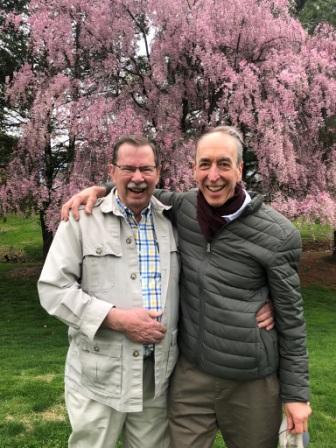
Next morning, after we have a photo shoot for a local newspaper in front of a beautiful blossoming Japanese cherry tree, HA drives us through Amish country where we pass horses and buggies driven by sedate folk in black or grey garb, and Amish tractors trundling along on steel wheels – no rubber. ‘They really shouldn’t be in the road’, HA says. ‘Look at the damage those steel wheels are causing.’
We head to an Amish Country Restaurant for lunch – one that clearly caters for the many tourists that flock to the area – but which still has an authentic feel.


I decide to order the Tuesday special – ‘Amish Wedding Meal’. Well, I feel wedded to this project of mine so why not have a meal to celebrate? Chicken and stuffing with sweet creamed celery, peppered cabbage and the creamiest, silkiest mashed potato I’ve ever tasted. Half portions are on offer for 2 dollars less. So I have a half portion. It’s enormous. Glad I didn’t go the whole hog. (Whole chicken). But it’s delicious. And some shoofly pie to follow. (Local speciality – made with molasses.). You can have it wet-bottom or dry-bottom. I ask HA for advice. ‘Wet-bottom is best,’ he suggests. So I ask for a slice of wet-bottom. Delicious.

Elizabethtown is the charming town nearby where the Church of the Brethren, a historic peace church, host us in their beautiful, unornamented church. None of the over-the-top colours and decoration seen in the Basilica at Notre Dame.

We set up our props and after a snack in a cafe downtown, come back to see the church filling up with 25, 50, 100, 150 people… some sat in pews very far back.

The weekend at Notre Dame had taken its toll on me and I’m dealing with a ragged and rather hoarse throat, but as we have been requested to wear lapel microphones due to the size of the church and because some will be hard of hearing, that helps me a little.
The response to the performance is wonderful – rapt attention, even from those far back in the pews. After we have left ‘the stage’ the audience/congregation sings Sibelius’ lovely song of peace, ‘This Is My Song’.
I’m busy changing my clothes but can clearly hear the singing and it’s very moving. Our performance has also been live-streamed for those who couldn’t attend in person – and there have already been over 150 views. In the Q and A, a Japanese woman tries to make a comment but is choked with emotion. She tells us that her grandmother survived the atomic bomb when she was twenty years old – but was never able to talk about it. This play seems to be making an even deeper impact on audiences here in the US than it has thus far in the UK.
Tired but content, Riko, Maria and myself are driven back by HA to our delightful Mennonite Guest House rooms, with flowering cherries and babbling water-features outside our windows. A late-night snack is followed by hours of undisturbed sleep.
Next morning, a friend and colleague of HA’s – Kenn Sensenig – gives us an expert guided tour of Amish Country – a place he’s known for most of his life.

Covered bridges (so horses don’t get spooked by the rushing waters below), Amish homes and farms, and a chance to look into a newish, large and very plain conservative Mennonite Meeting House.

There are hundreds of hooks above head height through half of the large rectangular space. ‘For the men to hang their hats on,’ Kenn informs us. ‘But not in the other half of the room?’ we ask. ‘That’s where the women sit. Separate from the men.’
Lunch is at the packed Oregon Dairy restaurant. Kenn tells us more about the local lifestyles – the sense of community engendered by having no use of motor vehicles, which could carry people to far off places; the controversy over cellphone use which some need to conduct their business.
We ask if Amish and conservative Mennonites know much about current world affairs? Politics? Do they vote? No, says Kenn. They leave governing to the government – and concern themselves only with following God’s word (in German and English).
We inevitably ask about local feeling generally towards the new President. Kenn looks round the packed restaurant. ‘Most of these will be Trump-voters,’ he says. He, HA and their community are Democrats mostly and in a minority here in eastern Pennsylvania. ‘But these are all good people,’ Kenn says. ‘I know many of them.’ ‘But do you discuss politics with them?’ we ask. ‘No. We don’t do that.’
That evening’s performance is at the Akron Mennonite Church where about 120 people turn up to watch.

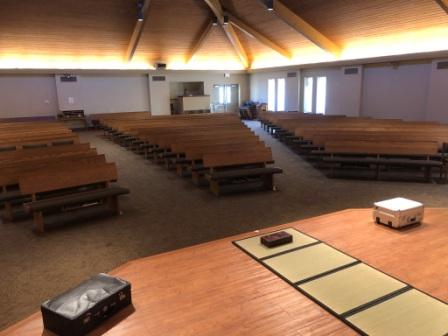
One of the Pastors, Rachel, gives an introduction – then makes some very funny jokes about mobile phones which gets the audience laughing and relaxed. She then brings everyone to a still moment of gathered concentration. I’m there in the church, standing at the side. I will start the play as soon as she finishes. She offers up a prayer.
‘Holy One,

God with many names,

May we listen this evening with open minds and hearts

To hear anew the truth and tragedy of war and violence.

May your spirit of peace challenge us and encourage us

To join peacebuilding work in all places at all times.

Seeking the wellbeing of all,

We breathe in love, joy and peace.  May it be so.’
What’s this? Tears in my eyes?
Wasn’t expecting that. And now I’ve got to start the performance.
As Adrian Freedman’s achingly beautiful shakuhachi flute plays, I dry my eyes, take a deep breath and step forward… ‘Not so long ago, in a faraway city…’
Chapter 6: With the Quakers in upstate New York
April 18th. You learn something new every day. Today I learned that ‘Nazi Democrats are all low-lifes’.
This was painted on a large board outside someone’s house on a quiet country road near Old Chatham in upstate New York. Joseph, our host and prime organiser for our two performances in the area on Good Friday and Easter Saturday (would anyone come? I wondered. Wouldn’t they all be on their Easter break, with family, or away visiting relatives?)…anyway, Joseph was driving us in his pickup truck (another story) to Patrick, a friend of his who, over time, has been a dancer, actor and is also a playwright – who happens to have also written a play about Hiroshima – something he’s been working on and a subject he’s been obsessed with for far longer even than myself. Since the age of ten, he tells us. (He’s now in his early seventies.)
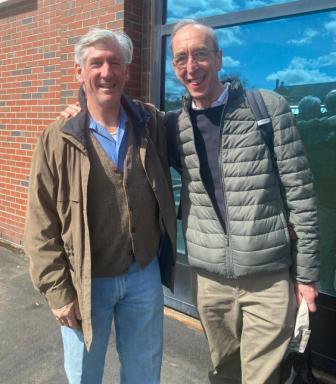
Out of the truck window I see an elderly couple – who look so sweet and charming – walking up the hill past the sign. ‘Joseph! Are they a couple of Nazi Democrats, by any chance?’
He chuckles.
At lunch Patrick tells us that the sign had been much larger but the owner was warned that it was too large – so he trimmed it down to ‘an acceptable size’, and there it stands, for all who pass it to wonder what the heck he actually means by that.
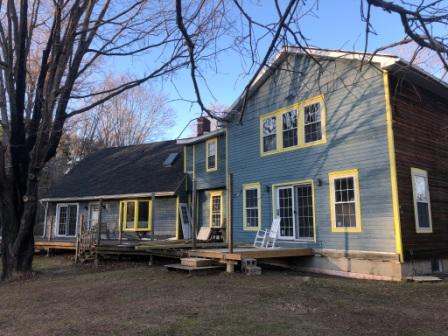
I stayed at Joseph’s house seven years ago, on my previous tour with my play ‘This Evil Thing’. Now both Riko and I are staying with him. His daughter is also staying – plus her dog, Nyla, who is very cute but also very curious, pushing her way into bedrooms, bathrooms, the trash cupboard, you name it. So everything has to be strapped shut with elasticated cords, making entering one’s bedroom at night a bit of a palaver. (‘How do I undo this frigging strap??’)
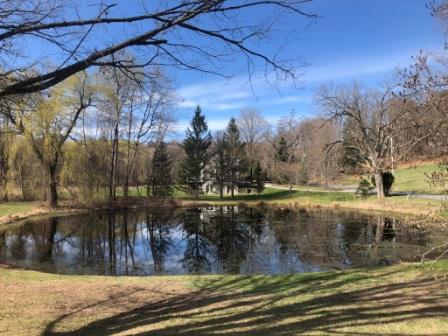
Outside the house, sits the tranquil pond I recall from seven years ago. Today it has baby turtles sunning themselves all along its fringes.
Joseph has a patio deck – which is perfect for doing yoga and offering sun-salutes…
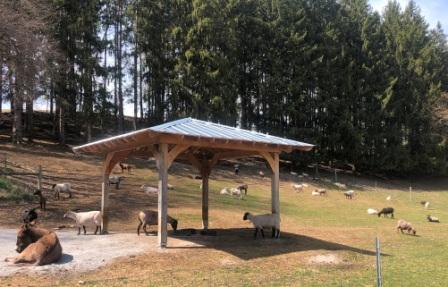
We have a morning to relax and chill in this idyllic setting before heading out to Patrick’s and then on to the venue.
The reason we’re going in a pickup truck is because the whiteboard Joseph has borrowed for us to use in the play is in the back of the truck. ‘Are there seats for the three of us, though?’ I ask.
‘One of you will have to sit on the small jump seat behind the passenger seat.’ Chivalrously I insist to Riko that she sit in front and I will attempt to fold my long limbs into and onto the jump seat somehow.
‘How long will the ride be?’
‘Only about 15 minutes. Oh, and truck is playing up so I’ve parked it on the hill up there and I’ll need you to help me give it a push downhill so I can jump start it.’
Jump starts, jump seats…show business, huh? There’s nothing like it.
Joseph puts the truck into neutral, and we start pushing and then I push and keep pushing as he hops inside and manages to get the engine running, we then load our suitcases of props next to the whiteboard, I crumple myself up into the jump seat and off we head, passing potential Nazi Democrats, up to Patrick’s place.
Some of the conversations at lunch (and at supper the previous evening) revolve around vaccines and the huge number that Americans receive from birth onwards. Seventy two, someone says. What? Seventy two? Vaccines?
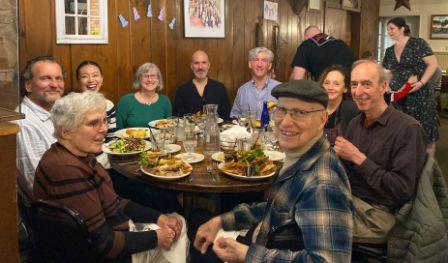
I realise that I am amongst a group that contains some ‘anti-vaxxers’ who at the same time are also passionately opposed to nuclear weapons. My mind is on the performance we’re about to give and I don’t feel I can confidently contribute to the vaccines debate at this point.
I’m not going to say that I welcomed and willingly accepted the Covid vaccines. This is a discussion for another time.
In addition to writing his play, Patrick has also built his own little theatre in which he has been creating the set and props for his play about Hiroshima. Including musical instruments. And puppets. He gives us a tour and it’s all very striking and impressive. I’m sorry that we won’t be around when it’s being performed.

But soon it’s time to head off to our own venue, to set up our own set and props.
We’re performing in a beautiful converted barn (no shoes allowed) at Mettabee Farm and Arts – and as we arrive sheep-shearing is in full swing outside. I decide against offering to help out.

We are to perform on a small raised stage – too small really, our props and whiteboard only just fitting onto it. And as 7 pm approaches it looks as if only about 3 or 4 people will be watching us. Joseph apologises to me. No need, I say, you’ve worked so hard to try and publicise this. But in the end there are about twenty, including Patrick.

I’m very conscious of his presence during the performance. What will he make of it? We are not rivals – not at all – I believe there can never be enough plays about Hiroshima and Nagasaki – but I realise we are performing for someone who is something of an expert and who has his own brilliant ideas on how to express these events theatrically.
I needn’t have worried.
During the Q and A afterwards, he is very generous. Hugely generous. ‘Well, the Brits have done it again…’. he says. He is full of praise and promises to get down to New York to see the play again but with full stage lighting and a theatre sound system.
The next day, Easter Saturday, we are performing at the Quaker Meeting House in Old Chatham at 2 pm in the afternoon. Once again I wonder ‘will anyone come?’ Oh yes. About forty or more turn up and fill the meeting room – which approximates the size of venue we’ll be playing in New York City in a few days – so it’s all good practice. We meet Don and Marion, Quakers who have travelled far and wide in their lives – including to Japan – doing excellent selfless work, including setting up the Never Again Campaign – a volunteer programme whereby they and other American families have hosted Japanese volunteers, who can then visit schools, colleges, communities, to spread the message of the atomic-bomb survivors and share Japanese culture to promote international understanding.
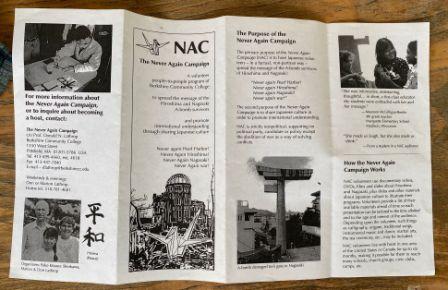
Don is 91 now, dapper and slim – but at supper at a local restaurant after the performance, he orders the largest Turkey club sandwich I have ever seen. I assume he had no idea just how large it would be. ‘Oh no, I’ve had it before,’ he tells me. ‘It’ll do me for two or three meals.’

Joseph, our host, has been and remains an inspiration to me. He is a Quaker who, some years ago, refused to pay taxes that would fund the military – for which he was pursued and ultimately charged and could have received a five year sentence. Because of his Quaker beliefs and principles, however, the judge was lenient – and only sentenced him to twenty six weekends in jail. Every weekend, Joseph would head off to jail. Other penalties and restrictions were also imposed: not being allowed to travel abroad or even out of the state for a number of years; losing his chiropractor’s licence. I ask myself, would I be willing to risk a jail sentence for my beliefs? Well, the way the world is going, there may yet come a time…
I am thrilled that he says he has written a book about his time in jail and that it will soon be published. I promise to do what I can to spread the word about it in the UK.
Joseph is such a good-hearted man and a true friend and I feel a little tearful saying farewell to him next morning at Albany railway station. We are taking the train to New York City. Amtrak have these guys known as Redcaps who help you with heavy luggage and cases.
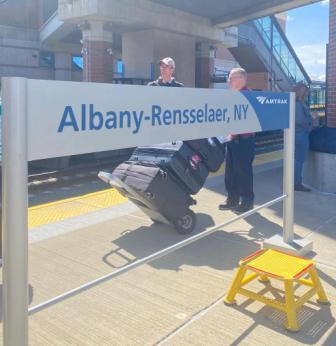
I needed one in New York City as we waited for the train upstate – but how much to tip, I wondered? In New York I offered $15, which was met with a grunt of disapproval. Okay. $20? Grudgingly, the New York City Redcap took it. But now, upstate, we have a very friendly and helpful Redcap called Mike.
Who asks Riko and myself all about the play. Who then gets us and our many cases safely stowed onto the train. Who I then tip with $20. Who then lights up, beaming all over his face. ‘Hey, I’ll come down to New York and see the play! When’s it on till?’ Clearly, my tip was a generous one and has made Redcap Mike very happy. Well, $20 will cover most of the price of a ticket for The Mistake. Redcap Mike leaves the train and waves to us. The train then pulls out of the station. New York, here we come…
Chapter 7: Before the House Un-American Activities Commitee (well, kind of )
Scene: a forbidding committee room arranged in the style of a courtroom. A stern official – seated – is firing questions at a British actor/playwright – who is standing in front of him.
‘It has come to our attention that an audience member at a performance of your play The Error – ‘
‘Mistake, your honour.’
‘Pardon me?’
‘The play is called The Mistake.’
‘Don’t interrupt again. An audience member at a performance of your play deemed it to be un-American.
I must therefore ask, are you now or have you ever been a playwright who depicts the sufferings of innocent victims of war? More specifically, a playwright who writes about the victims of American atomic bombs? A playwright opposed to war in all its forms and to the military-industrial complex?’
‘Yes. I am. And I stand by everything I’ve written. But it has never been my intention to create a work that was un-American. I have tried to portray all sides of the debate, of the conflict. Fairly. To give every character the opportunity to vigorously make their case.’
But I’m getting ahead of myself. Again. Back to my first full day in New York City – Monday April 21st – before we’ve even entered the theatre which will be our home for the next three weeks.
I find myself singing as I walk the streets downtown with our director Rosamunde Hutt, who flew in the day before.
‘New York, New York, it’s a wonderful town! The Bronx is up and the Battery’s down! The people ride in a hole in the ground! New York, New York, it’s a wonderful town!’
Well, the subway leaves a little to be desired. ‘Hole in the ground’ doesn’t seem so inappropriate a description. Makes the London Underground (which I normally have many complaints about) seem quite luxurious by comparison.
But a whole day off to explore a small part of the Big Apple. Exciting! First stop? It has to be Greenwich Village – on the trail of Bob Dylan’s early haunts and the haunts of many other famous folk… On the way we take in the iconic Flatiron building. Argh! It’s all covered up and surrounded by scaffolding.
Okay, on a little further to the Chelsea Hotel, dark and atmospheric inside with wild art on the walls of the lobby. Plaques outside the building honour the many artists who have stayed there.

My eye is drawn to one for Leonard Cohen, whose song ‘Anthem’, with its line ‘There is a crack in everything, that’s how the light gets in’ reminds me of Leo Szilard’s mantra uttered twice in my play, ‘We have to believe in a narrow margin of hope…’
Then further on we reach Cafe Wha? where the young Dylan first arrived and asked if he could sing a few songs – announcing the arrival of a remarkable new talent.

The recent excellent movie about Dylan’s arrival in Greenwich village was called A Complete Unknown. (Chalamet was brilliant, truly inhabiting the role of young Bob with great subtlety and nuance – why didn’t he get the Oscar?) I feel that the movie’s title is an appropriate description of myself, wandering around NYC, hoping to muster an audience for a play which is not remotely commercial, doesn’t have a star name and is not the kind of fare a theatergoer looking for a fun night out would choose.

It’s now time for ‘elevenses’. Which turns out to be hot cross buns at Tea and Sympathy – a British-themed tea room in the Village, with pictures of the late Queen and the current King gracing the walls – and a vast range of leaf teas to choose from served by none other than Molly from Dublin. ‘I’ll come and see your play,’ she promises.

Following the Dylan trail further, we reach the atmospheric Cafe Reggio, where the beat poets hung out, and which boasts being the home of the ‘original cappuccino’. The original coffee machine is still on display, a highly polished and most impressive-looking artefact. We, of course, have to order cappuccinos. Hmm. Not bad. Though not the best I’ve ever had.

There are a lot of links and circularity on this tour of ours. My first task on the tour was giving the talk on the role of the arts in promoting peace – which feels like a lifetime ago but in fact was just two weeks previously at Manchester University. During that talk I referenced and sang verses from Dylan’s early protest songs ‘ Masters of War’ and ‘Blowin’ in the Wind’. And here I am now in Greenwich Village paying homage at the places where he first performed such songs.
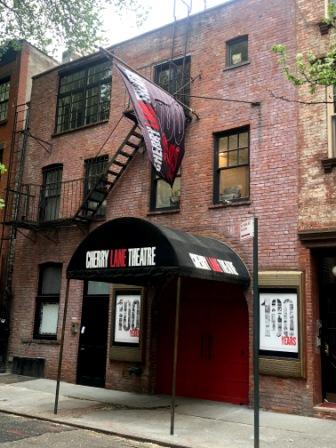

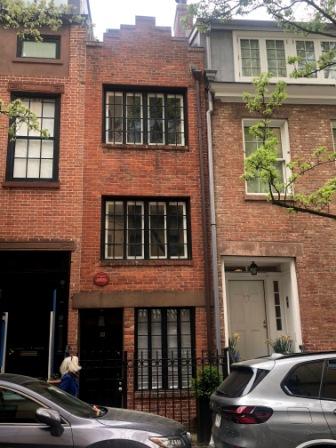
We walk along lovely tree-lined streets, full of attractive brownstone houses; past the Cherry Lane Theatre, the oldest continuously-running off-Broadway theatre in the city; past Henry James territory – Washington Square Park – with a jazz combo in full swing; on past 75 1/2 Bedford Street, the narrowest house in the Village, where the poet Edna St Vincent Millay lived for a while; past a fabulous mural featuring her and many other artistic icons including Bob Dylan, Woody Guthrie and Joan Baez.
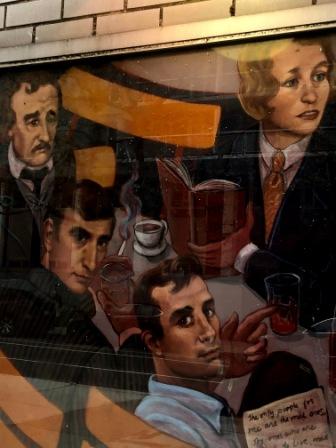


But hey, as the day draws to its conclusion, I’m not a tourist, I have to remind myself. Not just a tourist.
Next day, now in full actor/playwright/producer mode, I go into the theatre with Ros to find Riko and to meet Ant, our wonderful stage manager for the next three weeks, and we start preparing our performing area, check sound levels and witness Angelo Sagnelli our lighting designer working his magic in a small space with not very many lights to play with.
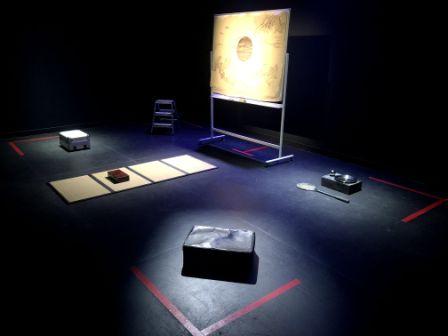
The whiteboard I have purchased just for this New York run is assembled and seems to work well. Though Mark Friend’s lovely canvases are not staying firmly on the magnetic surface of the whiteboard. As sewing is not something I have ever mastered, Riko and Ros kindly and wonderfully offer to sew more magnets onto the canvases, and that seems to do the trick.
We’ve loved performing in the variety of non-theatre venues prior to New York, but it adds another layer to the experience of the play that we now have numerous lighting effects as well as excellent speakers for Claire Windsor’s atmospheric soundscape.
And before we know it, it’s Thursday April 24th and we open The Mistake to two packed previews with tremendous audience feedback.
Apart from one negative comment.
‘ Un-American. That play is un-American.’
Provoking my flight of fancy at the start of this blog.
And yet the very next day, during the talkback after the performance, other Americans praise the fact that I didn’t remotely demonise the American pilot of the Enola Gay – the B29 bomber that dropped the first atomic bomb. That I didn’t make him a villain. That I humanised him and gave him space to state his case, the military’s case, strongly and with conviction. How did I do that, these American audience members wanted to know? Well, it’s what I always strive for – to show the complexity of these issues, that it’s never simply black and white.
The fact is that The Mistake is landing with far more impact here in the USA than it did in the UK – naturally. You can feel the electricity in the room as key scenes and moments unfold.
Many people share stories with us afterwards. A lady whose father had been killed by a kamikaze pilot, the play clearly being a difficult watch for her; the Jewish-American woman married to a Japanese man – whose family couldn’t accept her as she was American – ‘the enemy’. This woman, hugely impressed with the play, said it would be a hard sell right now with all the bad news happening in the US – people would not be keen on seeing such a serious subject matter, she felt.
And by the way – did you hear about the Enola Gay? As part of the recent US purge of DEI-related content (Diversity, Equality and Inclusion), images and posts mentioning the Enola Gay were flagged for removal. Because of the word ‘Gay’ it seems. But Enola Gay was pilot Paul Tibbet’s mother’s name! He used her name for the B29 bomber that dropped the first atomic bomb which led to victory in the Pacific War for the USA.
‘Nope, we’re not having the word ‘Gay’. Wipe that woke name from the records…’
What the hell is going on here?
What crazy times these are!
But when I say this, please realise – I’m not being un-American…
Chapter 8: Five Amazing Women … (Or – ‘Gonna take my problem to the United Nations…’)
Did you know – I’m ashamed to say I didn’t – that 928 nuclear bomb tests were conducted in the USA between 1951 and 1992 at the test site in Nevada? 928. Each one of which was more powerful than the atomic bombs dropped on Hiroshima and Nagasaki. Each one of which had ‘fallout’ which for those people and communities ‘downwind’ of those tests has proved lethal. In numbers of cases, fatal even.
One of the amazing women I met last week at the United Nations – (‘Hey, I thought you were in New York at 59E59 Theaters, not the UN!’ I hear you cry? I’ll explain shortly, don’t worry) – anyway, one of the women I met there is of that group who identify themselves as ‘downwinders’ – and she has been fighting for justice and compensation from the US government for years. She’s also written a play about her experiences. More of that shortly, too.
I mentioned previously how there have been so many links, loops and circularity on this tour of The Mistake in the US.
Well, in a rather extraordinary coincidence, which I did know about before leaving London, the latest round of talks on the Nuclear Non-Proliferation Treaty (NPT) are taking place at the United Nations, New York, at exactly the same time we are performing a play in the city about the dangers of nuclear weapons.
I had been in contact with CND UK about this, asking if they would be sending delegates.
In the end they weren’t able to, but British politician Jeremy Corbyn would be going on their behalf – and they were also able to arrange a temporary pass for myself so that I could attend some of the ‘side events’ taking place during the discussions – on so many related issues, and at which a variety of fascinating activists, would be speaking.Jeremy Corbyn would also come to The Mistake and lead the talkback afterwards.
Anyway. It’s my second week in New York. And yes, of course I’m at 59E59 Theaters. We’ve done seven performances of the play, had our official ‘opening night’ on April 29th, and next morning it’s time for me to head to the United Nations – a place I certainly never visited as a tourist on my previous trips to New York.
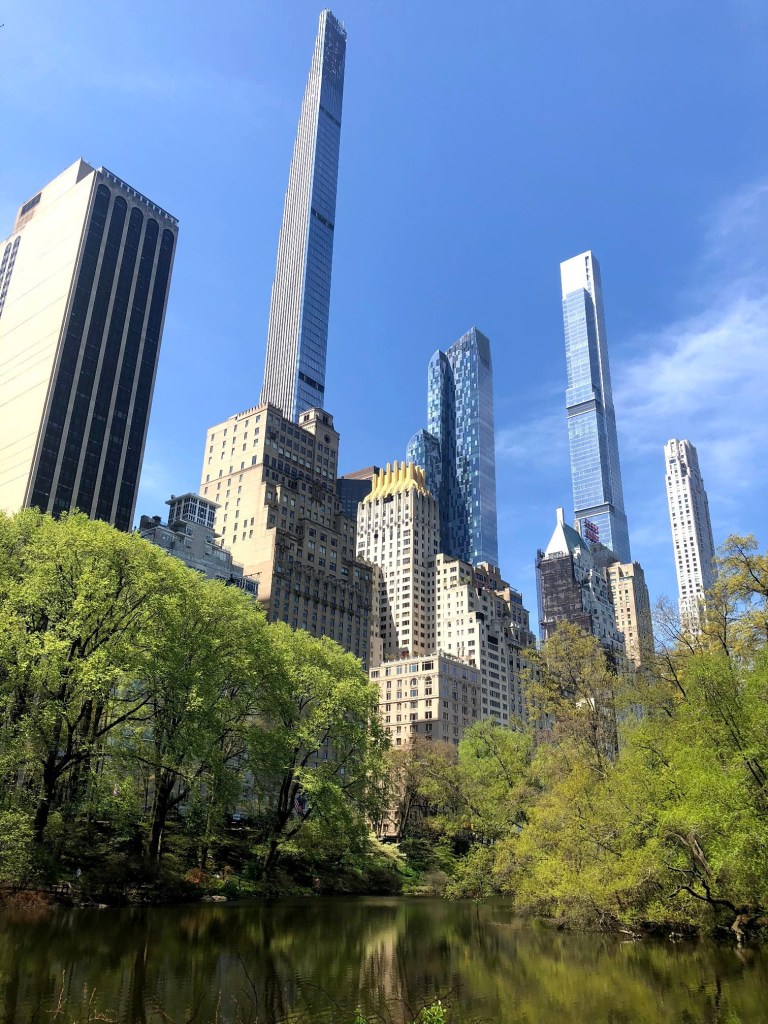
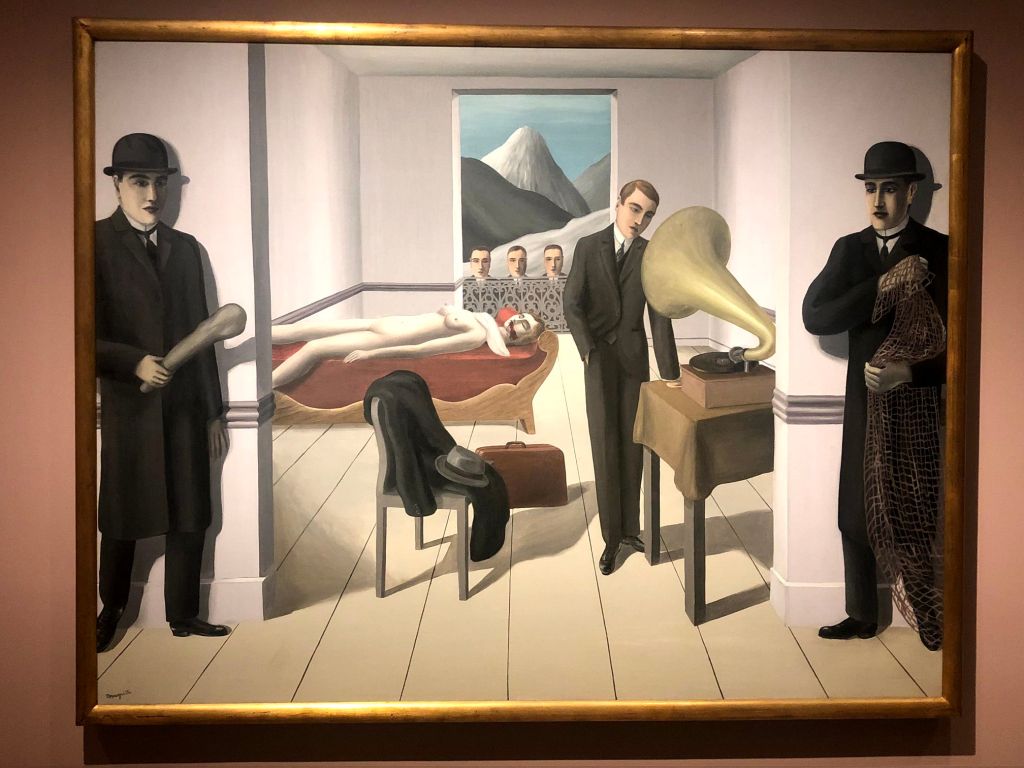

Before committing chunks of my remaining daytimes to attending talks and sessions, I manage to squeeze in some more tourist activities – wandering in Central Park, the trees at last full of fresh, young leaves and bursting with beautiful blossom; gazing at the infinite variety of different fire escapes stuck on the sides of buildings and apartment blocks; paying a visit to the Museum of Modern Art – where one of the first paintings to leap out at me is Rene Magritte’s large and wonderfully surreal ‘The Menaced Assassin’ – which inspired Tom Stoppard’s early play ‘After Magritte’ – a firm favourite of we teenage thespians at Enfield Youth Theatre, north London, in the 1970s. I particularly like the heads of the three chaps at the back furtively looking onto the scene. Our director Ros and I also pay a visit to St. Patrick’s Cathedral.

What I haven’t mentioned is that it was during our first week here in New York that the news came of Pope Francis’ death.
Inside the cathedral there are large crowds paying their respects to the late Pope. There are great quantities of white lilies perfuming the air, and an empty throne with a photo of the Pope, past which people slowly process. Many are kneeling, many are praying – and there is almost total silence in the vast awe-inspiring building. Such respect, such reverence.
I offer up my own thanks for all Pope Francis did in speaking out so passionately for peace and against war, for warning about the climate crisis, and for his genuine concern for the poor and oppressed. He had the courage to ‘speak truth to power’, declaring that not only is the use of nuclear weapons immoral but the possession of nuclear weapons is immoral. Did Joe Biden, devout Catholic, pay any heed to those words? Did the large numbers of devout Catholics in the US (and elsewhere) truly hear those words? ‘The possession of nuclear weapons is immoral.’
In this vast and beautiful cathedral I feel the long extinguished embers of my own Catholic upbringing stirring…just a little…
While word of mouth continues to grow for The Mistake in the evenings, by day I head to the United Nations, just a few blocks away, to listen to speakers and even raise my hand to ask a question. I’m somewhat in awe as I enter the building and try to find my bearings. So many important and significant decisions have been made inside these walls since 1945. Many of which sadly have not been adhered to or acted on by certain countries. On a screen in the foyer I see footage of Greta Thunberg’s impassioned speech at the UN in 2019, accusing the world of inaction over the climate crisis. ‘How DARE you!’ she cried, in tears of anger.
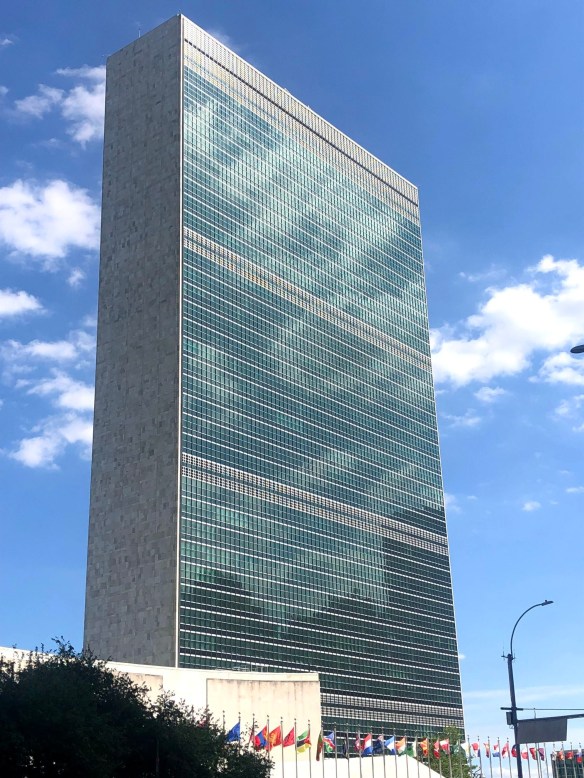
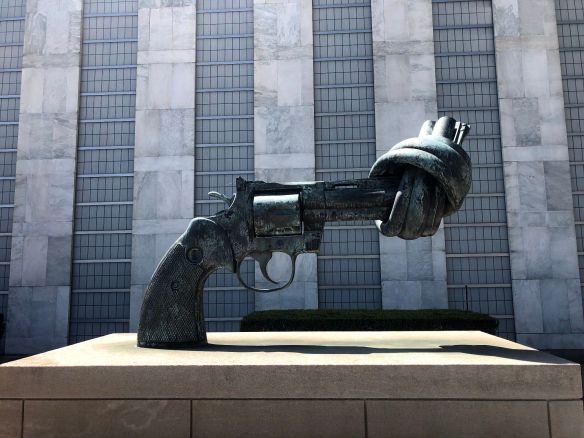
Outside the building and inside on the walls of halls and corridors are many moving and beautiful works of art, sculpture and installations donated by different nations from around the world.
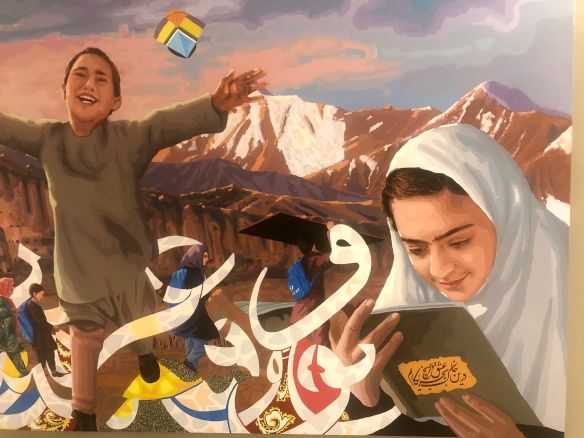
A large, vibrant painting from Afghanistan is full of joy – in the right hand corner a female student avidly reads a book.
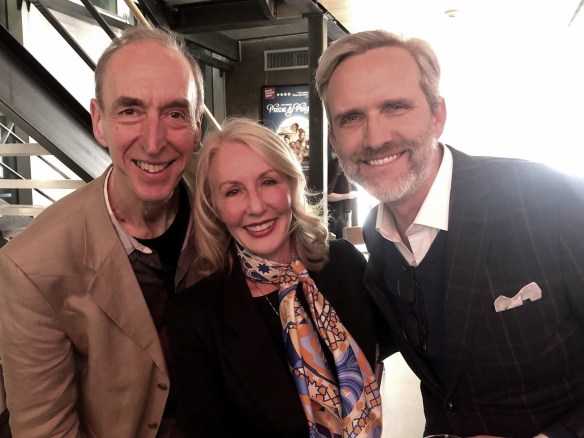
I bump into some Japanese students attending events – and they are from Hiroshima! They speak good English and I tell them about my play – they can’t get along to see it in New York but I tell them we will be in Japan in September. We all exchange contacts and have a group photo. ‘We are from ‘Mayors For Peace Youth’ they tell me.

At the first side-event I attend, I hear the testimony of Mitchie Takeuchi, whose grandfather was a doctor at the Red Cross Hospital in Hiroshima in 1945 and in the following years. He kept meticulous diaries of his experiences which Mitchie has only recently discovered. She has also been involved in a moving documentary film, The Vow From Hiroshima.
I head back to the theatre for the evening performance of The Mistake and the next day at the UN I attend a side-event ‘addressing the legacy of nuclear weapons’ – the ongoing effects on different communities around the world of radioactive fallout from nuclear testing. There are speakers from Kiribati and Fiji in the Pacific and from Kazakhstan – and also three extraordinary women – Veronique Christory, who among much other peace work has been senior arms advisor to the International Committee of the Red Cross for 28 years; Dr. Ivana Hughes, scientist, and president of the Nuclear Age Peace Foundation; and Mary Dickson.
Mary is a passionate campaigner for justice for the victims of radioactive fallout in the US. She has written a play about her experiences called ‘Exposed’. Joy and tears are close to the surface when she speaks. I am magnetised by her and the compelling testimony she shares. In her own words…
‘We’ll never know the exact numbers of those impacted by nuclear weapons and nuclear testing but it’s in the millions…’
‘These were not nuclear tests but nuclear detonations. Each more powerful than the bombs exploded on Hiroshima and Nagasaki.’
‘We were the collateral damage of the Cold War.’
‘50 people in just five blocks of our neighborhood developed cancers. I contracted thyroid cancer in my late 20s and was unable to have children. My older sister didn’t survive. Aged 46.’
‘Most Americans have no idea of their nuclear past.’
‘Our stories here in the US are shared with those of the Marshall Islands, Kazakhstan, those who were impacted by Chinese testing, French testing and so many others. In every case governments lied, minimised and covered up.’
‘All these tests have not prevented nuclear war, they ARE nuclear war.’
‘We continue to pressure our government to acknowledge the damage done to lives and communities and to compensate those affected – but the fact is nothing can bring back our loved ones. Nothing can bring back my sister.’
When Dr. Ivana Hughes speaks, she makes the succinct point that as scientists were part of the original problem, they now have to step up and be part of the solution. I think of Daniel Holz who we met three weeks earlier at the Physics Department in Chicago and his passionate opposition to nuclear weapons.
After the talk, I introduce myself to Veronique, Ivana and Mary. Mary is fascinated to hear about my own play – but says she is heading back to Salt Lake City in the morning and has plans that evening so sadly won’t be able to see a performance.
So I’m bowled over on arriving at the theatre later to be contacted by Veronique, who says Mary and her partner Steve have changed their plans and all three of them will be there that evening.
Earlier in the week, Jeremy Corbyn couldn’t attend the play or talkback – as in the end he hadn’t been able to find time to get to New York. A friend of his, Joseph Gerson, another inspiring peace activist and expert in the field, steps in for him.
The night Mary, Steve and Veronique come, we have another talkback scheduled, this time with artist, academic and activist Emily Welty. Yet another amazing woman. Mary is deeply moved by the play and we hug and hug and shed tears. We all talk for a long time in the bar until we are ‘thrown out’ and then continue our impassioned conversation on the sidewalk outside. Veronique will still be in the city for a few more days and says she will come to the play again, with other friends. ‘This play is SO important,’ she says, ‘I have to see it again.’ From someone who has advised the International Red Cross for 28 years, this is quite an accolade.
I feel humbled and honoured to be talking to these people.
Very few ‘show-biz people’ have turned up to see The Mistake, but that was never my motivation for putting on this play.
Mary gives me a final big hug and promises to send me her play. I am so looking forward to reading it. And perhaps seeing if I can help bring it to life in the UK.
What a time it’s been so far in New York City! The energy of the place. The buzz. The never-ending honking of car-horns. People are so much more vocal than in London, strangers talking to each other, shouting at each other. I am swept along and find myself doing this. I compliment a woman’s colourful jacket in a cafe. I pass a man in the street who is wearing the most gorgeous powder-blue suit with a hat to match, and I spontaneously cry out, ‘I LOVE the colour of your suit!’ As he crosses the busy road he calls back, ‘Why, thank you!’ – while I continue on my way to the theatre for another performance of The Mistake my head full of so many things, so much to think about, to process, to mull over…above all, feeling emboldened by all the extraordinary activists I’ve met.
Chapter 9: Harpo Marx and the Atomic Bomb
Towards the end of our second week of performances here in New York, the temperature outside shoots up into the high 70s and wouldn’t you know it, the air con in the theatre develops a fault. We have three weekend shows and it can’t be fixed till Monday. I’m not so concerned for myself, but for the audiences – full houses in a small theatre where they are watching a concentrated serious drama for eighty plus minutes with no interval.
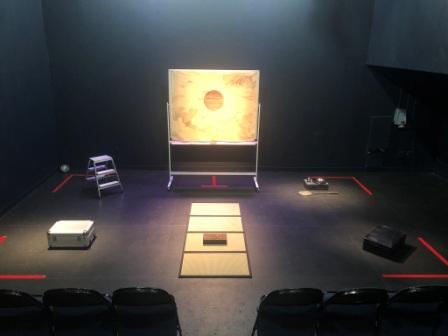
Amazingly, no-one leaves and no-one faints, though there’s a fair amount of programme flapping. Riko and I are drenched in sweat and by the end of the two Saturday shows I’m feeling pretty spent. We have a busy show the next day too, Sunday afternoon, and the heat persists. It’s astonishing that the audience stays with us, comes with us all the way on our journey into the Hiroshima ‘heart of darkness’ – saving their complaints until afterwards for the front of house managers.
On Sunday evening, having nothing planned, I am good for nothing anyway. I lie on my bed, at the downtown guest house where I’m staying, completely flaked out, wondering if I’m suffering from heat exhaustion.
I compose urgent emails to the theatre director and manager.
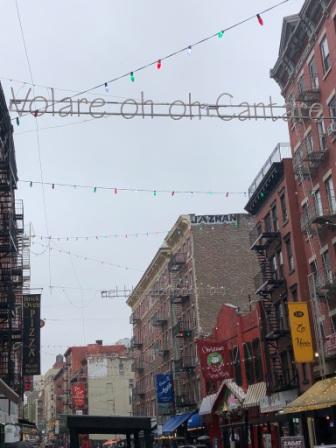
Next day, Monday May 4th, is a day off, and of course, it tips down with rain! Not until I’ve walked some of the wonderful, leafy High-Line, though; after which I wend my way to Little Italy – where the words of ‘Volare’ are spelled out in little lights, strung across the streets. I dive into a recommended restaurant, Zia Maria, and have a delicious lunch while watching the rain bucketing down outside. At least the temperature is cooler.

That evening I head to where Riko is staying – in a vast, wonderful house owned by Hungarian photographer, Clara, who has lived there for 40 plus years. In her large, artefact-filled ground floor apartment she hosts occasional artistic salons – and tonight a young Hungarian pianist, Alexandra Balog, will give a recital on Clara’s ageing Steinway (complete with squeaking pedal) prior to her Carnegie Hall debut in a few days time. Riko and I feel privileged to have been invited.


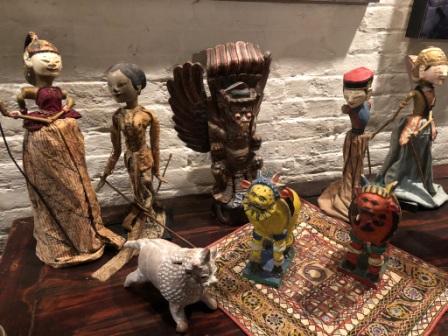
I also relish the opportunity to spend some time inside a New York City home. Alexandra rises to the challenge of the aforementioned squeaking pedal, not allowing it to affect her gorgeous rendition of Schubert’s B flat major piano sonata.

Next day I head back to the United Nations where, before attending a session, I witness more wonderful art – some Chagall windows (his stained glass is always so gorgeous); and the nearby specially designed ‘Meditation Room’.
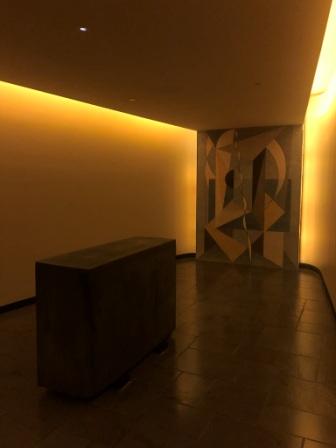
I go in and sit in the semi-darkness, pondering the fate of the world as I contemplate the mesmerising ‘stone’ in the centre of the room and the artwork on the wall behind. I reflect that, on the other side of ‘the pond’, the Cardinals in Rome will this week be deciding who the next Pope will be. Someone as committed to peace as Pope Francis was, hopefully.
When I go to the theatre that evening I anxiously walk into the space but…phew! – the air con is working again. What a relief.
Last week at the UN, I heard and met some amazing women. But there are some inspiring men working in the peace movement too. That Tuesday evening, Seth Shelden comes to see the play.
Seth is the United Nations liaison for the International Campaign to Abolish Nuclear Weapons (ICAN), which was instrumental in establishing the Treaty on the Prohibition of Nuclear Weapons (TPNW) and which won the Nobel Peace Prize in 2017. Seth has much legal expertise and speaks to governments, advocating implementation of the Treaty, also urging them to sign up to the treaty being discussed this week – on nuclear non-proliferation. Seth grew up in Brooklyn believing everything he was told about the end of WW2 and how the atomic bombs had brought the war to an end and saved so many lives. (A statement which is made but strongly disputed in my play.)
At the early age of 12, however, he came across John Hersey’s seminal book, ‘Hiroshima’, a brilliantly-written account of six survivors, and this proved to be a turning point in Seth’s young life, motivating everything he has done since for the cause of peace and to ensure these appalling weapons are never used again.
I’m reminded by his story of how profound an effect a book can have on a person’s life – even a short 120-page book (still published by Penguin and which I cannot recommend highly enough).
After the performance, Seth and I chat in the bar, and I’m surprised when he tells me that this theatre brings back memories for him – of when he had a critical success there.
‘So you’re an actor, too?’ I ask.
‘Well, not currently. My focus is almost totally on getting rid of these awful weapons – preventing any more catastrophes like the ones depicted in your play.’
I’m curious about his acting career. ‘What else have you done, what other roles have you enjoyed?’
‘Well, I played Harpo Marx off-Broadway in ‘I’ll Say She Is’ – the first revival of a lost Marx Brothers musical.’ Looking at Seth, I can see it – see how his looks and persona would suit the role of Harpo down to the ground. But as he has made clear to me, his main focus now is not on clowning and spreading laughter but on prohibiting the spread of nuclear weapons.
With memories of the Marx Brothers now in my mind, quotes from Groucho Marx inevitably surface. ‘Military intelligence is a contradiction in terms!’
After the performance there are other people to talk to. A friend of our London-based voice coach Kate Godfrey introduces himself to me. He found The Mistake very moving, but says his partner, who is Japanese, couldn’t join him this evening – and in any case she wouldn’t have been able to face the play as it would have been too painful for her. The fact being that her mother was a survivor of the second atomic bombing on Nagasaki.
Next morning I’m back at the UN and who should I bump into but Seth. We sit and have a chance of a longer chat. I tell him about some of the side events I’ve attended.
‘Have you been into the main conference discussions ?’ he asks. I say no, as they seem to be flagged up as ‘closed sessions’. But Seth says I should just slip in anyway, to get a sense of how it all works.
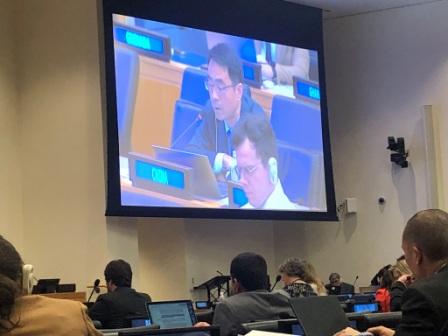
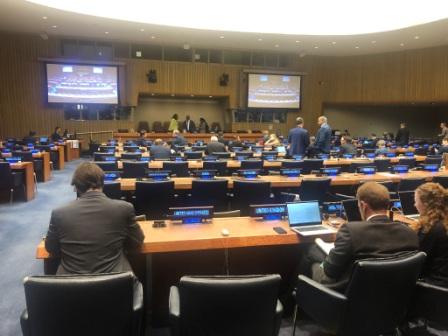
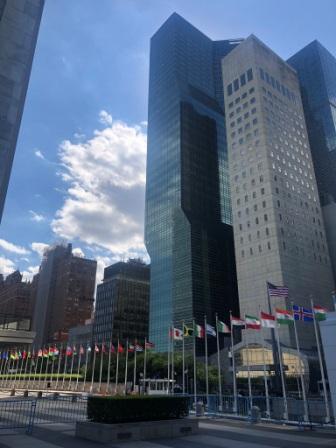
So I do. All the nations of the world each allotted a desk; numbers of them empty; a chairperson and others seated at the front; large screens on which the current speaker can be seen – who happens to be the delegate from the United Kingdom. Asking if in paragraph X certain words can be altered to other words, less demanding words. And in another paragraph, could this word be changed to that word. I later hear the Chinese delegate asking if the word ‘voluntary’ could be inserted. These are two of the nine nuclear-weapon states, of course. Offering their caveats and fudges. And so it goes on. Endless discussions about wording. Important, of course, when putting together a treaty. But seemingly so devoid of the passion I’ve witnessed in those speaking at the side events – like Mary Dickson and Mitchie Takeuchi last week. People who have directly experienced the consequences of these weapons.
I would have liked the chance to speak to the UK delegate, to invite him to the play. But I’d have been hard-pressed not to slip into Groucho Marx, saying something like, ‘I never forget a face. But in your case I’ll make an exception.’
That night after the play, an elderly man approaches me saying his father loaded the atomic bomb on the Enola Gay.
‘Really? Your father?’ I ask. ‘Yes, and I have his diaries. I can let you have a look at them as they might be useful for your research.’ People are often offering me books, articles, stories, saying they might be useful for my research. But the play is written and is making its impact. And frankly, I don’t have the time – or the inclination – to take on lots more research and rewriting.
(A not unrelated aspect of being a writer is that people are always offering ideas for plays. Someone once said to me that I should write a play about accountants. To which I replied, ‘Tell you what, who don’t YOU write a play about accountants?)
Thursday is my final visit to the UN. I attend a side event on the role of faith leaders in opposing nuclear weapons. But the speakers delay the start as they say the announcement of the new Pope is about to be made any moment now.
We all listen and watch as the first ever American is chosen as Pope, taking the name Pope Leo the 14th; a man who apparently has a highly developed social conscience and is not at all enamoured of the man currently enthroned in the White House. The man who just days before disrespectfully posted images of himself as Pope.
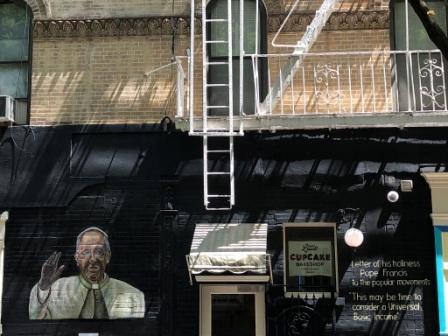
The session begins and speaker after speaker talks with great passion and intelligence about the immorality of nuclear weapons, not dilly-dallying about wording but cutting through to the core of the issue.
Afterwards I head to the theatre, preparing to portray another Leo who had a highly-developed social conscience – Leo Szilard, nuclear physicist.
Next day, Friday, is the last day of the deliberations at the UN and the draft treaty will be finalised and agreed upon. I won’t be able to attend as I have numerous other things to do – including having a massage for the serious neck and back tension I’ve developed during the tour. I learned that one of the Japanese members of our audience the other night is a massage therapist in the city, and as she had a slot free today, I decided to book it – especially as she would have seen just how physical the show is and what demands I make on my body during it. The massage is wonderful. Long overdue and deeply relaxing. Jojoba oil and citrus and rose oils. Serene cool jazz music. I ‘drop off’ several times. Afterwards I float towards the theatre on a cloud of relaxation where I briefly check my emails.
There’s news from Seth, at the UN…
‘Following two weeks of meetings that ended (as anticipated) without the adoption of an outcome document, the discussions illustrated a clear divide between the majority of countries, who are actively working towards nuclear disarmament, and the rest.
Pro-nuclear weapons states have demonstrated a profound lack of urgency in the face of increasingly urgent conditions.’
I feel some of the afternoon’s relaxation draining from my body with this news, and words from Harpo’s brother Groucho again spring to mind…’Politics is the art of looking for trouble, finding it everywhere, diagnosing it incorrectly and applying the wrong remedies.’ Or perhaps, feeling that the necessity to purge the world of these weapons would surely be something that everyone can agree with, I recall Groucho saying, ‘A child of five would understand this. Send someone to fetch a child of five!’
It’s now May 11th and we have arrived at the final performance of The Mistake on this US tour – which happens to take place on Mother’s Day…adding poignancy to the play every time Shigeko mentions her mother, desperately searching for her, plaintively calling her name until she ultimately realises the truth. Her mother had not survived the catastrophe.
We reach the last pages of the play and I say Leo’s final lines – the last lines I will speak onstage in New York this year – the words seeming to mean even more in the light of Friday’s failures at the UN – and I feel these words burning into the hearts of every audience member sitting in front or me – as I have felt them do so during this whole US tour – words with such an acute resonance for American audiences right now.
I look into the eyes of each person sitting in front of me as I declare, as Leo Szilard, ‘However desperate things may seem, we have to maintain, we have to believe, in a narrow margin of hope.’
Thanks to all who have supported this tour.
If you would still like to make a donation, please click here.
Thank you
 Michael Mears