‘I think it would have been good if you’d written something in the play about Okinawa and explored that…’. ‘I think it would have improved the play if there had been more history about the Japanese incursions into China…’
These comments from history students at Rugby School in Tokyo, who came to the theatre on Wednesday 17th September to see The Mistake.
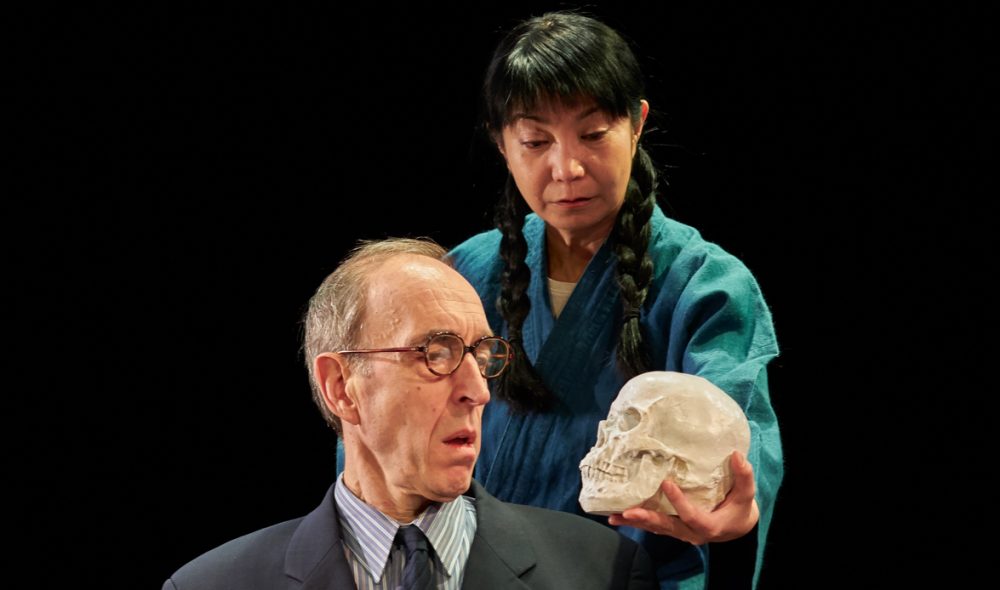
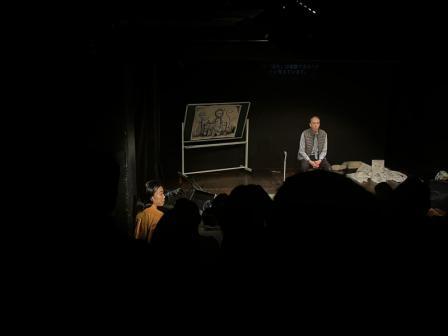
Yes, but… had I done the above, the play would be much longer and far less dramatic. The drama students from the school, however, were greatly taken with the staging, the simple props used in numerous ways, the character transitions, the swift switches in time and place – and all the students agreed that just two people telling such a powerful story in this way was, as one student kept reiterating:
‘Admirable. Really admirable.’
We were excited to have performed to two international schools but, as someone from the British Council in Japan said, after watching the play, ‘This really ought to be seen in Japanese schools.’ Yes, we’d love the opportunity to do that, but how?
I need to find someone in Japan who could set up such performances…
We’d now worked seven days non-stop and so all needed a day off.
I start my day off, as I have done most days in the last week, heading to a cafe I’ve discovered where the only noise is the gentle jazz they play – which enabled my first proper conversation in Japanese…
‘Watashi wa, kono jazz wa, suki desu! (I Iike this jazz!) Jazz wa, suki desu ka?’ (Do you like this jazz?)
To which the barista answers, ‘Hai. Suki desu.’
(Yeah, I like it.)
It’s as if I’ve been living in Japan all my life…
Talking of ‘character transitions’, after my cafe latte and cinnamon bun, I transition into a tourist, attempting to navigate the Tokyo Metro for the first time, heading for the impressive Meiji Shrine. I am not alone. Hundreds of other tourists have the same idea.
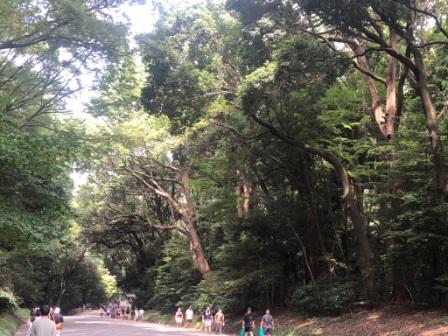
The Shrine is part of Yogogi Park and I walk under huge, towering trees to get there. I’m actually doing some ‘forest-bathing’, as the Japanese have coined it – and it’s very soothing.
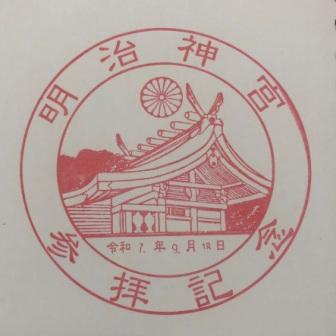
After reaching the shrine, I follow the ritual of throwing in a few coins, bowing twice, clapping my hands twice then bowing once more – while offering up a wish for success for the rest of our Japanese tour, and a wish that our audiences continue to watch with open hearts and minds.


There is a lovely ‘inner garden’ next door, far less crowded, with a water-lily pond and tranquil walkways…I realise I’m feeling pretty wound-up, what with the demands of the tour – the pre-tour prep, the long journey here, then opening the show in Tokyo and the subsequent performances. A gentle stroll in a Japanese garden is just what the doctor ordered.
While in tourist mode, I head to Tokyo Station to book my ‘bullet-train’ tickets for next week when we will head south – and I see a sign saying that in the event of an earthquake, ‘the entire building may sway slowly’! I’m not sure how to react. Anxious that I’m in earthquake-territory, or reassured that if it happens while buying train tickets, the building I’m in will only sway slowly and not collapse.


I go for a stroll in the area close to my digs and there’s a sign informing me that I’m on Broadway – Nakano Broadway this time! Off-Broadway, New York in May, Nakano Broadway, Tokyo in September.

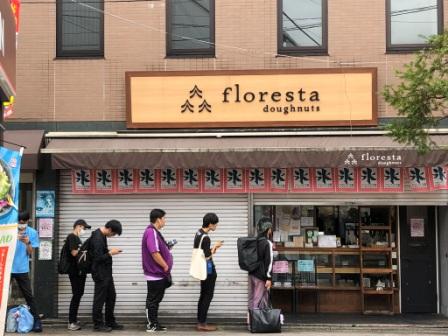
I pass a doughnut shop with a large queue forming outside waiting for it to open – but I don’t know the Japanese for ‘Are the doughnuts that good here?’ – so I walk on and reach a lovely little bakery, where an old man sees me staring in the window, and ushers me in. I say, ‘No, after you,’ (in sign language) – but he insists, and I soon realise he is the owner along with his wife.
So as well as purchasing pastries, I have my second major conversation in Japanese which in translation runs something like this…
The wife: ‘You speak good Japanese!’
Me: ‘Oh, not really. Only a little.’
‘No, it’s very good.’
‘No, not that good. Long way to go yet…’
And that’s when I peter out. I don’t ask whether she has any cream puffs because I can see that she doesn’t.
That evening, in a restaurant where no English is spoken, I just about manage to order something, and then I point to a tempting picture of a glass of pineapple juice. When I take a couple of swigs it nearly blows my head off. ‘Arukoru?’ (Alcohol?)
‘Hai!’ replies the waiter.
Hmm, I’ve not been drinking any alcohol while doing this play, to keep me as razor sharp as possible. But as a result of this mix-up, I at least learn the word for ‘non-alcoholic drink’. Not a difficult word. ‘Sofuto durinko.’
We have four more performances in Tokyo, plus two Q and A sessions, plus our get-out, all in the space of three days. Some people travel considerable distances to see us: my friend Sam and his wife Mukti come from one hundred miles away, Professor Toru Kataoka, who has been avidly supporting us on social media, flies from Hokkaido to see us, and I nearly jump out of my skin when I notice someone in the audience who resembles the American student, Caroline, who I coached via Zoom in Shakespearean acting during the Covid years. In fact, it is her!
‘What are you doing in Tokyo??’
‘I’m studying music now and am in Tokyo for a month taking a series of master classes.’
On this morning of our last Tokyo performance – which happens to be September 21st and the International Day of Peace appropriately enough – a Japanese journalist interviews Riko and myself. She asks me a number of interesting questions about my intentions and motivations, and then asks me when I was born. ‘One hundred years ago next Tuesday, ’ I jest. But she’s serious. So I confess the truth. Sixty eight.
Revealing this fact to a journalist, it hits me afresh like a piece of new information. Am I really that age? And if I am, should I be lugging huge suitcases around the globe before and after giving a non-stop eighty five minute high-octane, sweat-busting performance with just one other actor? Shouldn’t I be taking it a little bit easier? Or at least, shouldn’t I try harder to find the money to pay a stage manager to join us on our travels and lighten my heavy load?
Questions I have no answers for right now.
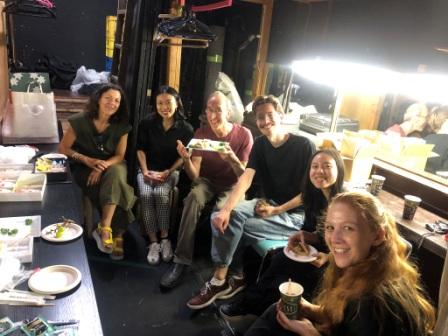
Anyway, the last Tokyo show is over. We talk to our guests, then start packing up, and Maria, Riko and I lug the set and props suitcases to a nearby transport firm – located on Nakano Broadway as it happens – before heading back to the theatre for an ‘English tea party’ with our special little crew. Sandwiches, cakes and delicacies and English Breakfast tea.
During tea, I make the mistake – yes, the mistake – of opening an email from a Japanese theatre producer – whose English is not great – and who has some complimentary things to say about the play, but also some negative things. So many Japanese people in our audiences have had nothing but positive responses to The Mistake, but of course, it’s this one set of negative comments that will inevitably prey on my mind. I don’t agree with most of the producer’s reservations but he does make some interesting points about the expression of anger in the play and the harbouring of hatred for the enemy.
But I can’t think about that right now – so I close my phone and pour myself another cuppa.
Gifts are exchanged, hugs are had, laughter and tears are shed, and then it’s a fond farewell to Jalani and her team – as we head south the next morning on the bullet-train: the sleek, futuristic (and always on time) Shinkansen, which will spirit us at speeds of 120 miles an hour to our next destination, Tottori, and the Bird Theatre Festival. The stations at which the train will stop are flashed up in English as well as in Japanese and, as I sit back in my very comfortable seat, I realise that if I stayed on this train it would take me directly to Hiroshima.


‘Not yet,’ I say to myself. That extraordinary experience is still a week away.
 Michael Mears