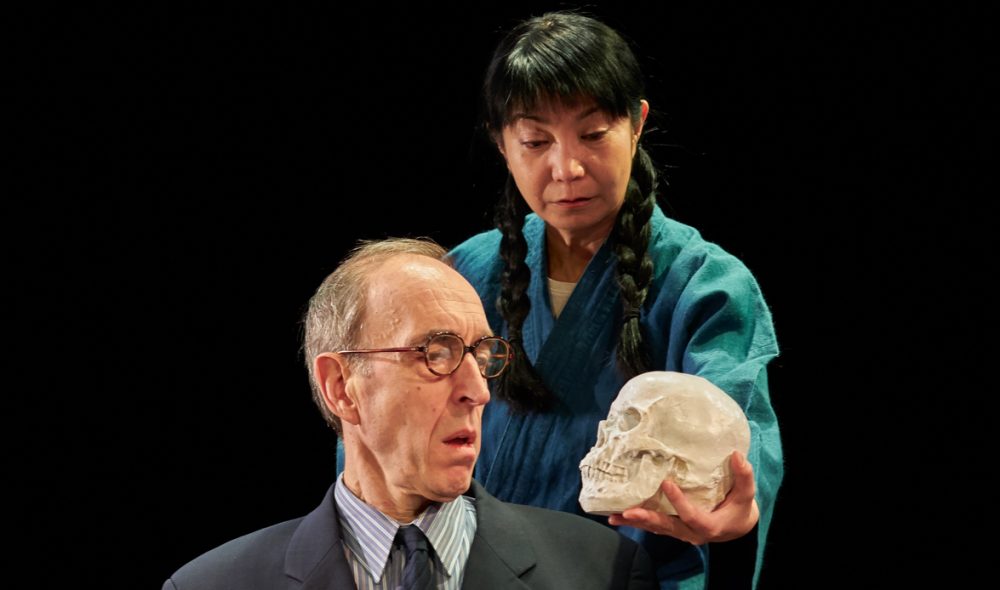
Did you know – I’m ashamed to say I didn’t – that 928 nuclear bomb tests were conducted in the USA between 1951 and 1992 at the test site in Nevada? 928. Each one of which was more powerful than the atomic bombs dropped on Hiroshima and Nagasaki. Each one of which had ‘fallout’ which for those people and communities ‘downwind’ of those tests has proved lethal. In numbers of cases, fatal even.
One of the amazing women I met last week at the United Nations – (‘Hey, I thought you were in New York at 59E59 Theaters, not the UN!’ I hear you cry? I’ll explain shortly, don’t worry) – anyway, one of the women I met there is of that group who identify themselves as ‘downwinders’ – and she has been fighting for justice and compensation from the US government for years. She’s also written a play about her experiences. More of that shortly, too.
I mentioned previously how there have been so many links, loops and circularity on this tour of The Mistake in the US.
Well, in a rather extraordinary coincidence, which I did know about before leaving London, the latest round of talks on the Nuclear Non-Proliferation Treaty (NPT) are taking place at the United Nations, New York, at exactly the same time we are performing a play in the city about the dangers of nuclear weapons.
I had been in contact with CND UK about this, asking if they would be sending delegates.
In the end they weren’t able to, but British politician Jeremy Corbyn would be going on their behalf – and they were also able to arrange a temporary pass for myself so that I could attend some of the ‘side events’ taking place during the discussions – on so many related issues, and at which a variety of fascinating activists, would be speaking.Jeremy Corbyn would also come to The Mistake and lead the talkback afterwards.
Anyway. It’s my second week in New York. And yes, of course I’m at 59E59 Theaters. We’ve done seven performances of the play, had our official ‘opening night’ on April 29th, and next morning it’s time for me to head to the United Nations – a place I certainly never visited as a tourist on my previous trips to New York.
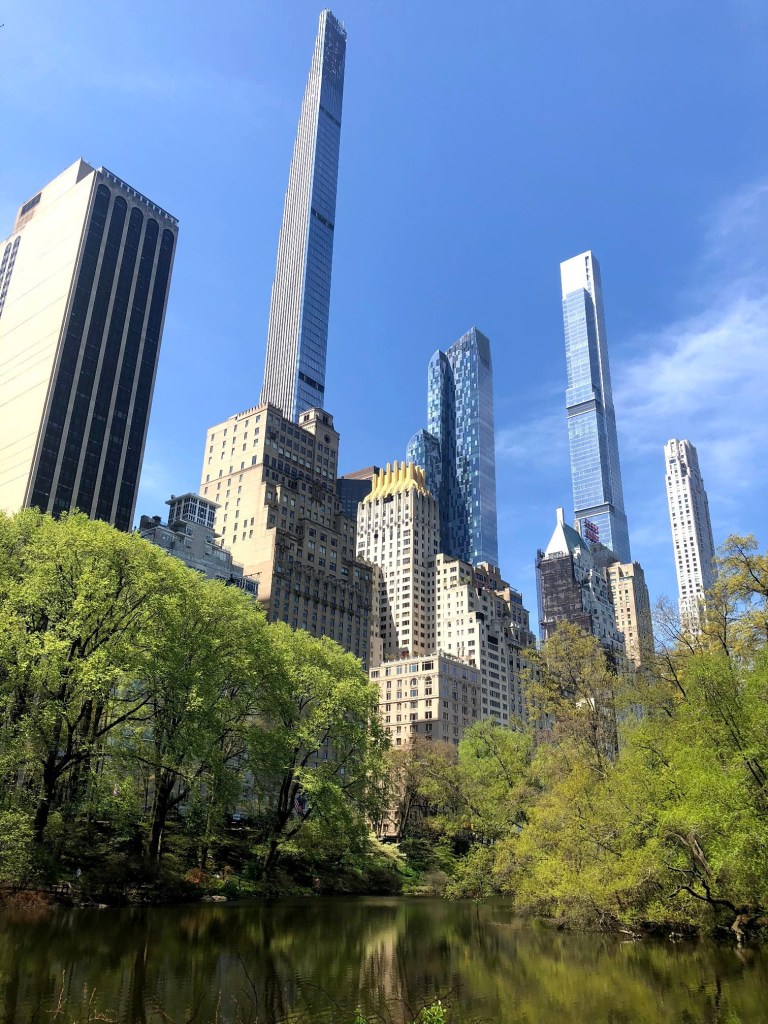
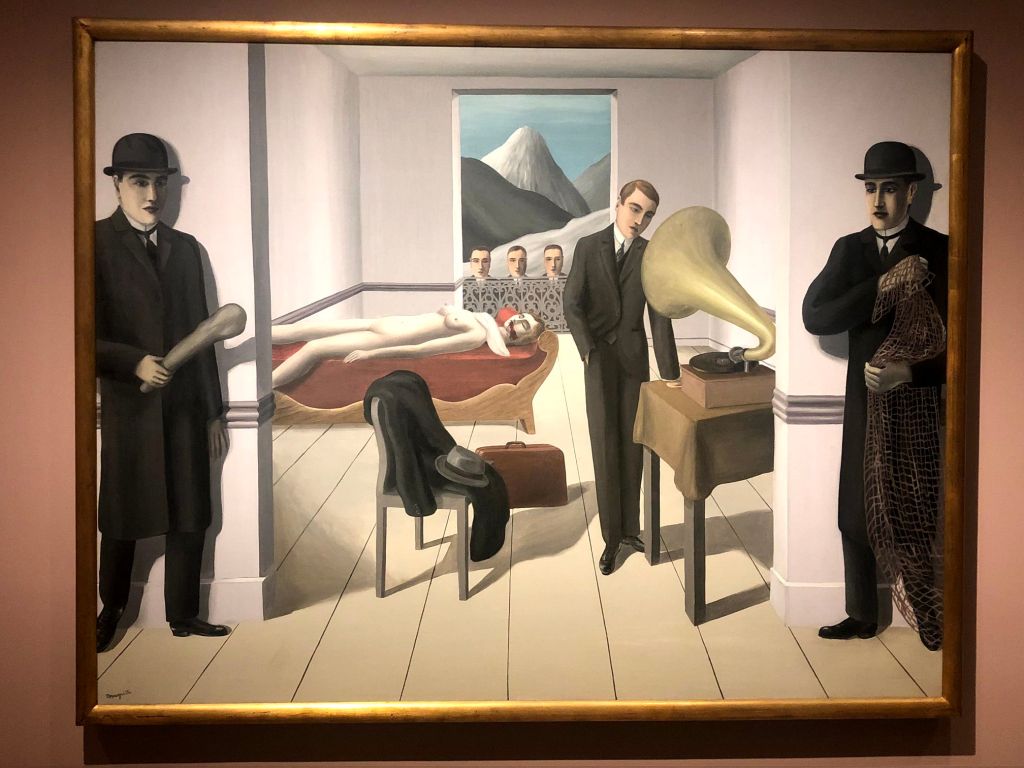

Before committing chunks of my remaining daytimes to attending talks and sessions, I manage to squeeze in some more tourist activities – wandering in Central Park, the trees at last full of fresh, young leaves and bursting with beautiful blossom; gazing at the infinite variety of different fire escapes stuck on the sides of buildings and apartment blocks; paying a visit to the Museum of Modern Art – where one of the first paintings to leap out at me is Rene Magritte’s large and wonderfully surreal ‘The Menaced Assassin’ – which inspired Tom Stoppard’s early play ‘After Magritte’ – a firm favourite of we teenage thespians at Enfield Youth Theatre, north London, in the 1970s. I particularly like the heads of the three chaps at the back furtively looking onto the scene. Our director Ros and I also pay a visit to St. Patrick’s Cathedral.

What I haven’t mentioned is that it was during our first week here in New York that the news came of Pope Francis’ death. Inside the cathedral there are large crowds paying their respects to the late Pope. There are great quantities of white lilies perfuming the air, and an empty throne with a photo of the Pope, past which people slowly process. Many are kneeling, many are praying – and there is almost total silence in the vast awe-inspiring building. Such respect, such reverence. I offer up my own thanks for all Pope Francis did in speaking out so passionately for peace and against war, for warning about the climate crisis, and for his genuine concern for the poor and oppressed. He had the courage to ‘speak truth to power’, declaring that not only is the use of nuclear weapons immoral but the possession of nuclear weapons is immoral. Did Joe Biden, devout Catholic, pay any heed to those words? Did the large numbers of devout Catholics in the US (and elsewhere) truly hear those words? ‘The possession of nuclear weapons is immoral.’ In this vast and beautiful cathedral I feel the long extinguished embers of my own Catholic upbringing stirring…just a little…
While word of mouth continues to grow for The Mistake in the evenings, by day I head to the United Nations, just a few blocks away, to listen to speakers and even raise my hand to ask a question. I’m somewhat in awe as I enter the building and try to find my bearings. So many important and significant decisions have been made inside these walls since 1945. Many of which sadly have not been adhered to or acted on by certain countries. On a screen in the foyer I see footage of Greta Thunberg’s impassioned speech at the UN in 2019, accusing the world of inaction over the climate crisis. ‘How DARE you!’ she cried, in tears of anger.
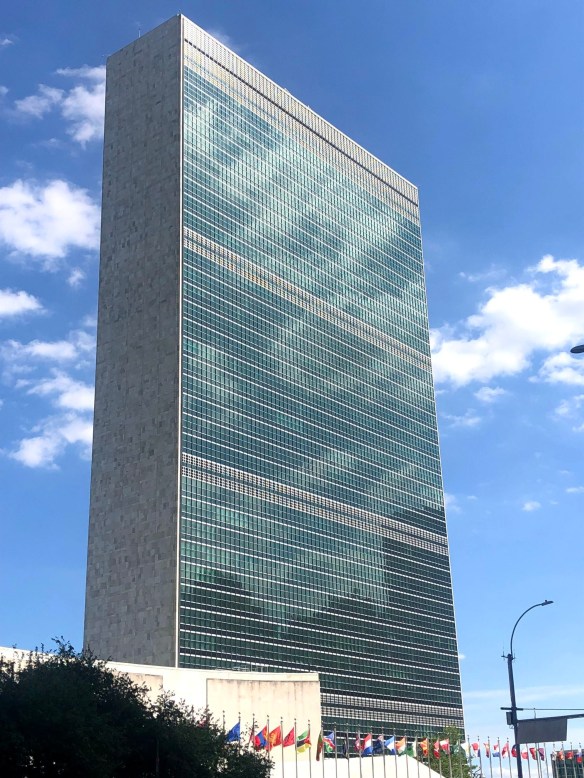
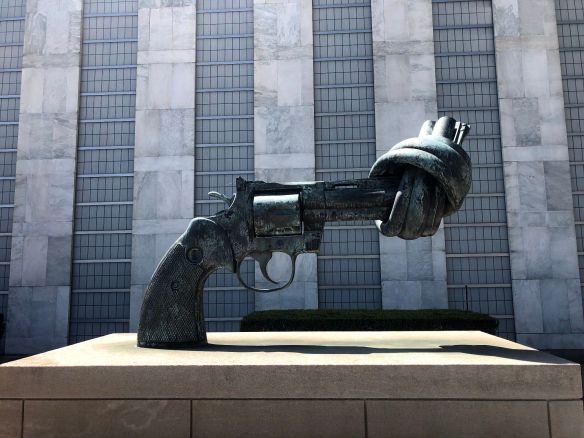
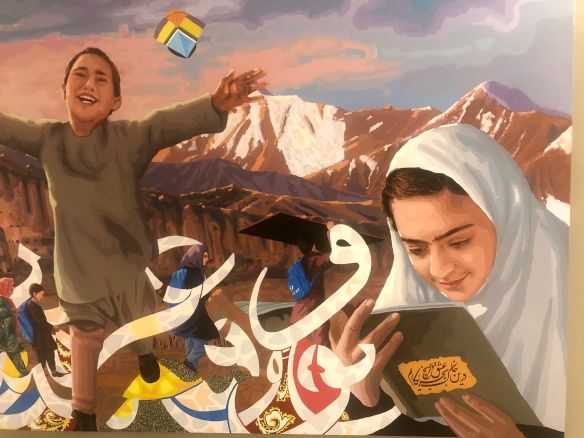
Outside the building and inside on the walls of halls and corridors are many moving and beautiful works of art, sculpture and installations donated by different nations from around the world.
A large, vibrant painting from Afghanistan is full of joy – in the right hand corner a female student avidly reads a book.
I bump into some Japanese students attending events – and they are from Hiroshima! They speak good English and I tell them about my play – they can’t get along to see it in New York but I tell them we will be in Japan in September. We all exchange contacts and have a group photo. ‘We are from ‘Mayors For Peace Youth’ they tell me.

At the first side-event I attend, I hear the testimony of Mitchie Takeuchi, whose grandfather was a doctor at the Red Cross Hospital in Hiroshima in 1945 and in the following years. He kept meticulous diaries of his experiences which Mitchie has only recently discovered. She has also been involved in a moving documentary film, The Vow From Hiroshima.
I head back to the theatre for the evening performance of The Mistake and the next day at the UN I attend a side-event ‘addressing the legacy of nuclear weapons’ – the ongoing effects on different communities around the world of radioactive fallout from nuclear testing. There are speakers from Kiribati and Fiji in the Pacific and from Kazakhstan – and also three extraordinary women – Veronique Christory, who among much other peace work has been senior arms advisor to the International Committee of the Red Cross for 28 years; Dr. Ivana Hughes, scientist, and president of the Nuclear Age Peace Foundation; and Mary Dickson.
Mary is a passionate campaigner for justice for the victims of radioactive fallout in the US. She has written a play about her experiences called ‘Exposed’. Joy and tears are close to the surface when she speaks. I am magnetised by her and the compelling testimony she shares. In her own words…
‘We’ll never know the exact numbers of those impacted by nuclear weapons and nuclear testing but it’s in the millions…’
‘These were not nuclear tests but nuclear detonations. Each more powerful than the bombs exploded on Hiroshima and Nagasaki.’
‘We were the collateral damage of the Cold War.’
‘50 people in just five blocks of our neighborhood developed cancers. I contracted thyroid cancer in my late 20s and was unable to have children. My older sister didn’t survive. Aged 46.’
‘Most Americans have no idea of their nuclear past.’
‘Our stories here in the US are shared with those of the Marshall Islands, Kazakhstan, those who were impacted by Chinese testing, French testing and so many others. In every case governments lied, minimised and covered up.’
‘All these tests have not prevented nuclear war, they ARE nuclear war.’
‘We continue to pressure our government to acknowledge the damage done to lives and communities and to compensate those affected – but the fact is nothing can bring back our loved ones. Nothing can bring back my sister.’
When Dr. Ivana Hughes speaks, she makes the succinct point that as scientists were part of the original problem, they now have to step up and be part of the solution. I think of Daniel Holz who we met three weeks earlier at the Physics Department in Chicago and his passionate opposition to nuclear weapons.
After the talk, I introduce myself to Veronique, Ivana and Mary. Mary is fascinated to hear about my own play – but says she is heading back to Salt Lake City in the morning and has plans that evening so sadly won’t be able to see a performance.
So I’m bowled over on arriving at the theatre later to be contacted by Veronique, who says Mary and her partner Steve have changed their plans and all three of them will be there that evening.
Earlier in the week, Jeremy Corbyn couldn’t attend the play or talkback – as in the end he hadn’t been able to find time to get to New York. A friend of his, Joseph Gerson, another inspiring peace activist and expert in the field, steps in for him. And now the night Mary, Steve and Veronique come, we have another talkback scheduled, this time with artist, academic and activist Emily Welty. Yet another amazing woman. Mary is deeply moved by the play and we hug and hug and shed tears. We all talk for a long time in the bar until we are ‘thrown out’ and then continue our impassioned conversation on the sidewalk outside. Veronique will still be in the city for a few more days and says she will come to the play again, with other friends. ‘This play is SO important,’ she says, ‘I have to see it again.’ From someone who has advised the International Red Cross for 28 years, this is quite an accolade.
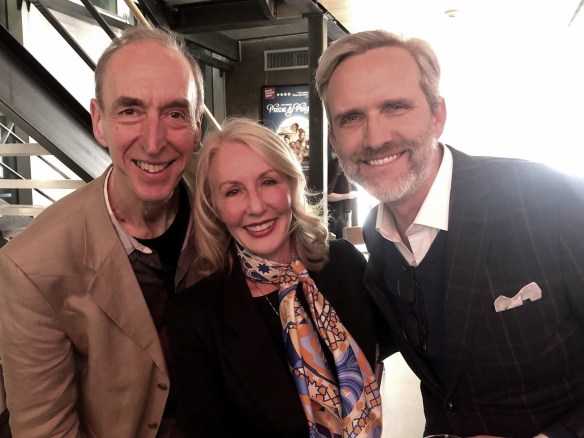
I feel humbled and honoured to be talking to these people.
Very few ‘show-biz people’ have turned up to see The Mistake, but that was never my motivation for putting on this play.
Mary gives me a final big hug and promises to send me her play. I am so looking forward to reading it. And perhaps seeing if I can help bring it to life in the UK.
What a time it’s been so far in New York City! The energy of the place. The buzz. The never-ending honking of car-horns. People are so much more vocal than in London, strangers talking to each other, shouting at each other. I am swept along and find myself doing this. I compliment a woman’s colourful jacket in a cafe. I pass a man in the street who is wearing the most gorgeous powder-blue suit with a hat to match, and I spontaneously cry out, ‘I LOVE the colour of your suit!’ As he crosses the busy road he calls back, ‘Why, thank you!’ – while I continue on my way to the theatre for another performance of The Mistake my head full of so many things, so much to think about, to process, to mull over…above all, feeling emboldened by all the extraordinary activists I’ve met.
 Michael Mears