
The huge campus of the famous US university of Notre Dame in South Bend, Indiana, is a place where Holy Cross Drive intersects with Frank Leahy Drive.


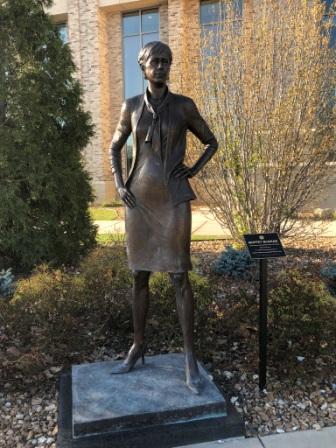
A place where you walk past sculptures of the same Frank Leahy (a famous Notre Dame football coach), then past a statue of the fabulously named women’s basketball coach Muffet McGraw (oh, yes) and then, after a short walk, past the huge, beautiful mural known as Touchdown Jesus.
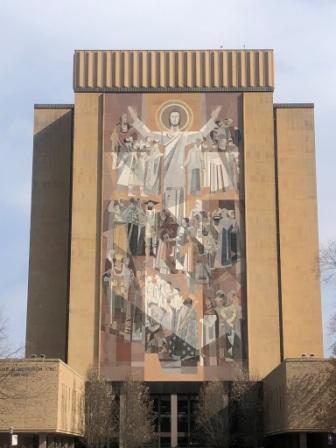
I kid you not. Jesus with his arms raised as if signalling a touchdown in American football. The mural is on the north side of the impressive Hesburgh Library – and is visible from the vast Notre Dame stadium nearby. (Sports, religion, sports…)
The mural is officially known as ‘The Word of Life’ and depicts Jesus with teachers, scholars and scribes below looking up to him. Inside the library, round the four walls of the entrance hall, run the words, ‘Let the library be a place where that hunger for truth keeps getting stronger…’
I audibly groan. What has happened to that ‘hunger for truth’ in this land, that now seems permanently tormented by accusations of fake news? Where scientists’ irrefutable findings regarding the impending climate crisis are constantly being…well, refuted.
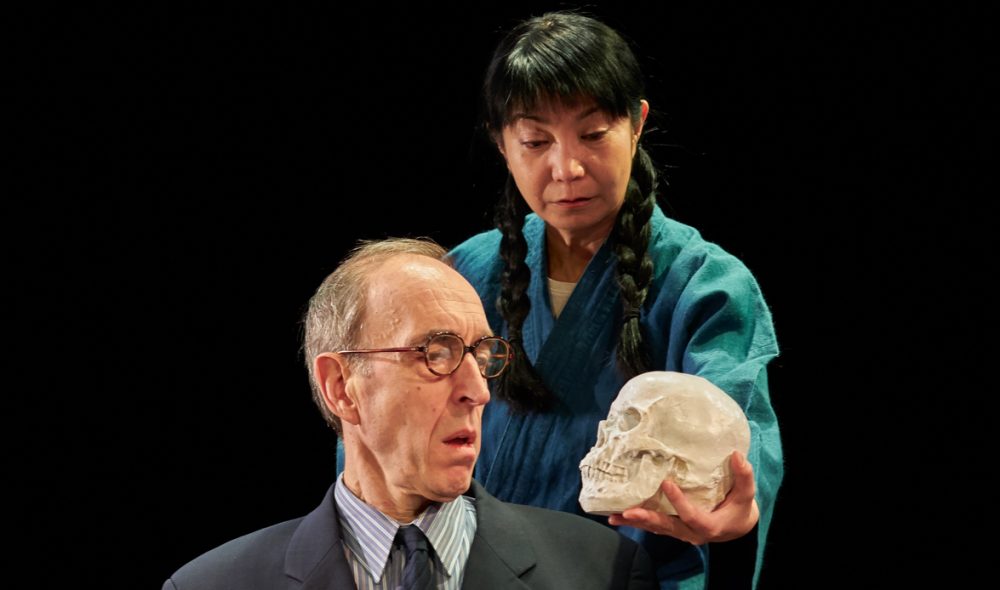
My play The Mistake endeavours to portray some truths…about what happened on the ground in Hiroshima in 1945; truths with which most politicians and world leaders refuse to engage.
But here at Notre Dame, we have been invited by the Kroc Institute for International Peace Studies and the Nanovic Institute to explore those truths before a University audience.
We arrive at Notre Dame on Saturday afternoon just before an American football game and the place is rammed with hundreds of cars, thousands of people, much noise and excited hubbub.
We have the chance to take a quick look at our space – we will be in the large Patricia George Decio Theatre at the Performing Arts Centre – a space far larger than we normally play – but when we ask for the tabs to be brought in that makes our playing space more compact. And though it’s a large auditorium, it feels very actor-friendly.

When we step out into the sunshine again, the football game is over and many hundreds of green-shirted fans are thronging the sidewalks. (Sports peace sports…)
We have time for some campus sightseeing before returning to our nearby hotel – which is also on campus (it’s quite a large campus – er, did I mention that?).
I head off to look at the distinctive gold dome of the main building then go into the colourfully ornate basilica next door – which I visited seven years ago when in South Bend (but not at the University) with my previous play.

I then walk down towards one of the lakes on campus, St. Mary’s Lake, near the Grotto of Our Lady of Lourdes. The Grotto is a one-seventh-size replica of the famous French shrine where the Virgin Mary appeared to Saint Bernadette on eighteen occasions in 1858.
There are hundreds of candles, a small representation of Bernadette kneeling before Our Lady – and kneeling before these are actual living Saturday afternoon folk in 2025 – some wearing Notre Dame football tops – and all praying…presumably for victory – or giving thanks for it. (Sports religion sports…)
I head back to the hotel via the huge campus bookshop. I want to check out their Peace Studies section – the Kroc Institute at Notre Dame being one of the world’s leading centres for the study of the causes of violent conflict and strategies for sustainable peace.
Erm, hang on.
Have I walked into the wrong place? Sports clothing, sports caps, mugs, souvenirs, memorabilia, you name it, all emblazoned with the distinctive Notre Dame ND initials, fill every corner of the ground floor. It’s a sports clothing emporium not a bookshop! Oh but wait…a small sign suggests there might be some books upstairs …and okay, yes, here are some academic tomes, some books on religious studies, books on peace studies, but let’s be honest, guys, this is basically a sports store. (Sports sports religion peace sports…)
Near our charming little hotel there’s a famous bar – the Linebacker – (football term, right?) and, being a Saturday night after a big game and on a large student campus, the bar is rather lively, to say the least. The kind of ‘lively’ that relishes throbbingly-pounding eardrum-shattering music. Until at least two in the morning.
How do I know? The bar is just across the road from my bedroom.
But I have earplugs, don’t I? Yeah, right, as if that makes a difference. Not a good night for me. And we’re due in the theatre at 9.30 am as we need to get ready for the performance which is scheduled for 4 pm.
I drag myself through waves of tiredness, urging myself to dig deep, give it my best shot, go the extra mile, give 200 per cent, search for the hero inside myself – and other such only marginally helpful phrases.
(Peace sports peace sports sleep please sleep…)
We have a small but deeply attentive audience. Well, it is 4 pm on a Sunday afternoon and many people will have made other plans. Some of which may well have included sports, perhaps. (Or even possibly sports.)
But at least Gerard (Jerry) Powers, who is director of Catholic peacebuilding studies for the Kroc Institute, is here – to introduce the play and watch the performance – having first apologised to us that he can’t facilitate the Q and A afterwards or even stay to the end of the play as he will be beginning his Lenten Retreat at 6pm. (At least he wasn’t heading off to see a football game.)
In the Q and A, one person praises our inventive use of such simple props (which all fit into just two suitcases, I inform her). She also loved the choreography of our movements.
Another woman says that though she goes to the theatre regularly and this is one of the most memorable pieces of work she has seen… she insists it should be seen on Broadway. I say, well, we are soon to have a three week run off-Broadway.
She says, no, we should be on Broadway itself and beyond. Everywhere should see this play. ‘Are you a producer by any chance?’ I ask. No. She isn’t.
Someone else points out a significant Notre Dame connection to the subject matter of the play. Bernie Waldman was an American physicist on the faculty of ND before WW2: he took an absence of leave to join Robert Oppenheimer and the Manhattan Project to build the bomb, and then flew as part of the Hiroshima Atomic Bombing mission itself in the observation plane as a cameraman. He returned to continue his work at Notre Dame. How amazing it would have been if we could have performed for and talked to him! But he died in 1986.
Every place we play, though…all these links to The Mistake.
Next day I drop Jerry Powers a line of thanks and say I’m sorry he missed the end of the play. I describe what happens at the end and the reason I chose a final sound effect of Japanese children’s singing being harshly interrupted by a threatening air-raid siren… a symbolic warning of the ever-present danger of nuclear weapons. But he writes back saying that although he’d promised his wife he would definitely leave the play early so he could get back in time, he was so captivated by what he was seeing that he couldn’t tear himself away. I’ll take that as a big compliment – the kind of impact we strive to achieve with each performance of The Mistake.
(Peace peace peace…)
To support this tour with a donation, please click here.
Thank you
 Michael Mears