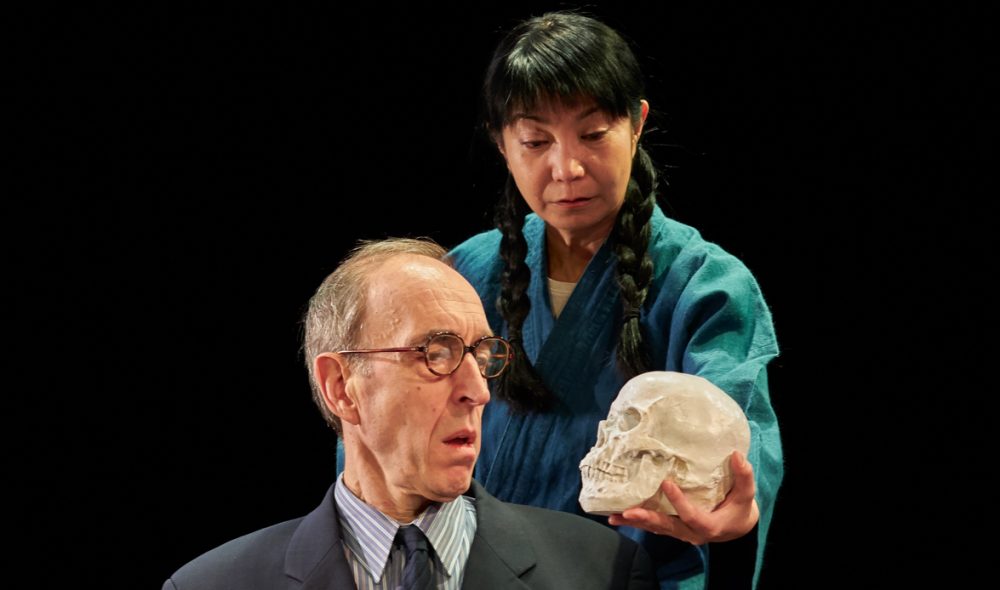
So far on this tour, I’ve felt butterflies, goosebumps and now shivers down the spine.
Let me explain. You can spend so much time in emails and phone calls and Zooms – as I have, trying to pin down a particular venue for The Mistake in different parts of the US – and then all that effort comes to nothing. On the other hand, you can shoot off one speculative email – as I did just one month before leaving for the US – which was way too late – and get an immediate positive response and booking. Such was Chicago.
I had tried for months to get a performance in the Windy City to no avail. Various very promising options fell through late on – after I’d (perhaps foolishly) booked flights and Airbnbs. But that last minute speculative email of mine was to the Chair of the Department of Physics at the University of Chicago, Peter Littlewood – to which he responded that, yes, they’d love to host us on one of the dates we were in Chicago, in the Physics Department Lecture Theatre. I was beyond thrilled at the news.
So…Day 7 – after treating us to a fabulous breakfast at a lovely coffeehouse in downtown sleepy Manchester, Katy and Libby waved us off with our many suitcases and we began the three hour trip back to Chicago: Manny once again at the wheel of his voluminous (it needed to be) Lincoln Navigator. We were headed straight to the University of Chicago to set up and prepare for a 6 pm performance. We didn’t have much time to be ‘tourists’ but we managed a quick look around.

In the street nearby is a sculpture by Henry Moore called Nuclear Energy. First wave of shivers down my spine. The sculpture marks the exact spot where the first successful chain reaction experiment took place in 1942 – on a squash court beneath a now demolished football stadium – the experiment being an event portrayed in my play. However, on the plaque it only refers to its commemorating ‘the first controlled release of nuclear energy’. No mention of what the successful experiment led to – the atomic bombs that destroyed Hiroshima and Nagasaki. Hmm…

We head inside – past bustling physics labs full of students who look fiendishly intelligent.

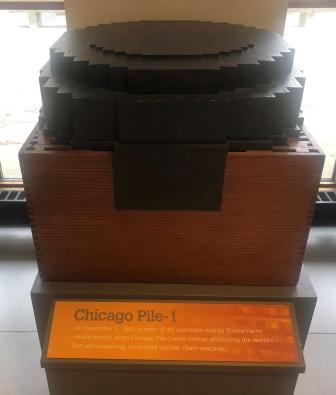
On the walls of the corridors are information boards and pictures of some of the scientists I portray in the play – Leo Szilard, Enrico Fermi…more shivers. There’s a model of the original nuclear pile – which we symbolically recreate in the play with just a few items.
We’re pinching ourselves – are we actually going to perform the play here? It’s hard to take it all in.

An immovable desk on the right side of our performance space in the lecture hall makes it all quite tight and compact.

And the audio can only be operated from that desk – so the operator will be very visible throughout the performance. How to capitalise on this? Maria, our brilliant associate producer, has offered to operate the sound cues today and she agrees to my suggestion that she wears a spare white lab-coat we have in our props. Perfect!

At the back of the space are large blackboards covered with countless chalked-up equations. Should we erase them? I think not – as they add much appropriate atmosphere. But is there a mobile blackboard for us to use in the play? Yes! One has been provided – and it is magnificent! Large, heavy, steely and not easy to manipulate. But when it becomes the Enola Gay, the board tilting up to resemble steely wings, the whole effect is threateningly chilling.
We have to get a move on though, if we’re going to be ready for 6 pm. But we just about sort everything and then Riko and I retreat to our makeshift dressing room – a room off the hall with desks and shelves full of scientific and technical clutter. People start arriving. Scientists. Physicists. Some quite elderly and distinguished. Some non-scientific people too.
The performance goes very well and at every reference in it to the University of Chicago I feel more shivers down the spine. Riko’s line as a nervous scientist at the experiment – ‘It wouldn’t look good if we blew up Chicago’ – gets the biggest laugh of the night. Not that we’re performing a comedy, you understand. At the end of the performance some of the scientists are visibly moved. Emotional.
Daniel Holz, a younger physicist, cosmologist, astrophysicist, you name it, has agreed to facilitate the post-show discussion.
He has Brian Cox-like charm and good looks (Cox the scientist and British TV celeb, not Cox the thespian).
Daniel is chair of the committee of experts who meet each year to set the hands of the Doomsday Clock, which is a measure of just how much danger – how ‘close to midnight’ – those experts believe the world is in currently.
This January, the committee moved the hands a second closer – to 89 seconds to midnight – and I altered the reference to the Doomsday Clock in the play accordingly.
Daniel is passionate about his work, and passionate about alerting people to the dire threat posed by nuclear weapons. He says that as the play went on, it exerted a real grip on him – and that it was quite something witnessing in this lecture hall, this physics department, this University the scenes about the creation of the atomic bomb – and witnessing Riko enact so movingly the heart-rending story of an atomic bomb survivor.
Daniel expresses the view that his committee are in danger of viewing the Doomsday Clock as an intellectual exercise, and aren’t engaging with it emotionally, viscerally. He feels they really need to see this play – which he believes would have a real impact on them. He talks a lot about the need for making an impact.
We were honoured and humbled that such a significant scientist thought the play and production were so important, urgent, and extremely timely.
We pack our things away, Maria reluctantly hands back her labcoat (it was a really good look for her!) and I can’t leave the lecture hall without asking Daniel to quickly check my equations – the ones I chalk up on the board in the early part of the play. He laughs. ‘They were okay,’ he says, strolling over to the board to take a look at my work. ‘That one is correct and relevant – but this one?’ He can’t help smiling. ‘It’s correct but it’s not at all relevant to your subject matter.’ ‘Okay,’ – I have to stop myself saying ‘Sir’ – ‘But can you give me a new one then, and I promise I’ll learn it and how to write it?’ He says he’ll email me something.
Ah well, sciences never were my strong point…but I have to say it’s pretty cool having your equations corrected by the man who sets the hands of the Doomsday Clock.
When I drop a line of thanks to the Physics Chair, Peter Littlewood, who was out of town and unable to attend that evening, writes back saying, ‘As a physicist, the nuclear bomb is original sin. We have to live with it and learn from it. But it is important we do not forget it, and in many ways most importantly for our physics students to recognize the burden and responsibility they inherit.’
To support this tour with a donation, please click here.
Thank you
 Michael Mears